

My Macedonian Mission – Kings, Christians, and a lot of bling!
by Dr. Kerry Phelan (@KerryLPhelan on X/Twitter)
One of the necessary responsibilities – perks? – of my job is travelling to Hellene’s destination countries and carrying out the regular in-person audits of the hotels that we use for our school groups. And in May 2026, Thessaloniki was my main port of call.
While I was chatting with one of the hotel staff after one such audit there, she asked me about my first impressions of Greece’s second largest city; I gushed enthusiastically about falling in love with Thessaloniki, and indeed the wider Macedonia area, and she replied by perfectly encapsulating her home city as being ‘Athens light’. And that summed it up perfectly; a smaller, stylish and more relaxed alternative to Athens, Thessaloniki is an urban gem for those in search of a destination that combines ancient history, art, spirituality, and gastronomy.
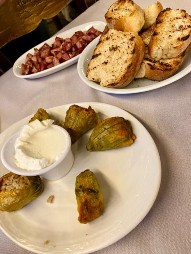
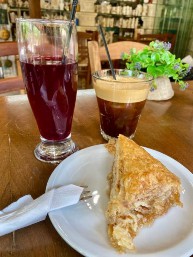
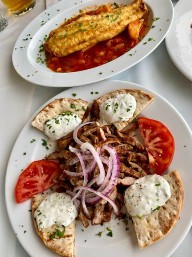
But let’s start at the beginning. Convincing my husband to accompany me on my recon trip to northern Greece was easy enough – any excuse to escape from the usual weather back home! – but what proved to be more challenging was convincing him of the need to hire a car and not only chauffeur me around (no, I’m certainly not brave enough to drive in Greece!) but to actually come along with me to one essential landmark after another; this took far more nagging than it ought to have done!
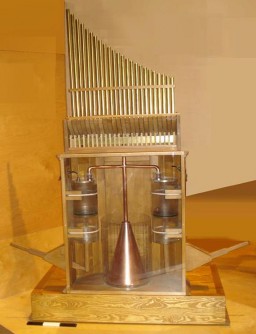
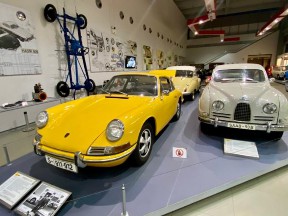
For the Macedonian mission to begin, we had to be at the airport at an ungodly hour since our Ryanair flight took off just after sunrise; on the plus side, of course, that always leaves time on the first day to squeeze in some visits. And so, on the way from the airport to our hotel in Thessaloniki, we stopped off at the NOESIS Science Centre & Technology Museum (approx. 15-mins from the airport by car). The Technology Museum is divided into three main exhibits: Ancient Greek Technology, Classic Cars, and the Technopark. For me, of course, I most enjoyed exploring the hall of Ancient Greek technology; displaying brilliant reconstructions of the hydraulis, Archimedes’ Screw, the Antikythera Mechanism, Ctesibius’ Water Clock, and Ptolemy’s Astrolabe to name just some of the highlights.
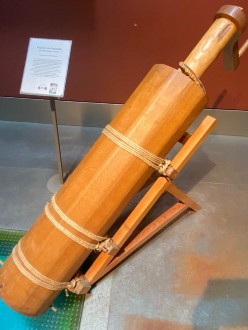
It’s a compact exhibit and has some information cards in English (though not many, and so it would be worth taking the 360 tour of the hall before visiting with a non-Greek speaking group of students!). My husband, however, was more impressed by the Classic Cars on show. And, surprisingly, I must admit that we both actually enjoyed the physics experiments in the Technopark; there were many hand-on tests and examples for visitors to try for themselves, from electricity to magnetism, mechanics, and even optics. While this exhibit is very generally aimed 8-15 year olds, it was clear to see from other visitors also that it was actually quite fun for students and adults alike!
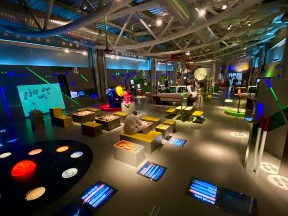
Moreover, NOESIS is home to an impressive Science Centre too, which has numerous screening on offer with a mix of Greek and English language presentations (as such, planning in advance would be a must); unfortunately, we didn’t have enough time to watch either an astronomy show at the Planetarium or a 3D movie in the Cosmotheatre (it was a feature on dinosaurs that day), nor to experience one of the spectacles in the motion Simulator – by this stage, we were starting to feel the effects of that very early start! But I would certainly recommend just a brief visit like we did, or even a full day there for those with younger children; it certainly offers something a little different to do when travelling to or from the airport.
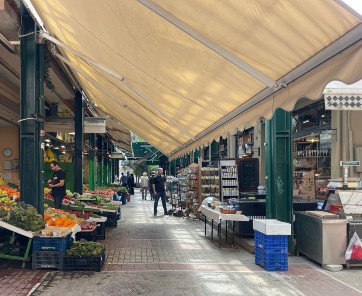
After checking-in to our hotel – and a brief power nap! – we set off that evening to explore some of nearby attractions. First we headed towards Athonos Square; this is a small but very vibrant market area which is now a popular stop for foodies, given the abundance of traditional tavernas and cafés serving original Greek dishes and trendier street food. In addition to the eateries, stalls selling fruit and vegetables are mixed in with cobblers and artisan crafts and jewellers; it was lovely to stretch our legs, and just meander through the narrow paved streets of the market, taking in the bustle of both shoppers and hungry tourists. Less than a few minutes away, Aristotelous Square is one of the most famous spots in Thessaloniki; sitting on the waterfront, this grandiose space was designed by French architect, Ernest Hébrard, in the early 20th century to mimic the sophistication of traditional European architecture. Named, of course, in honour of Aristotle – who is honoured with a statue there – at one end, this central Square is formally flanked by the Electra Palace Hotel and Olympion Cinema, and the other overlooks the Thermaikos Gulf; the remaining sides surround its visitors by shops, restaurants and bars and, as such, it’s a great spot to eat, take in the sea views, or just enjoy some people-watching from the many public benches dotted around. There, we enjoyed a meal – what the guy sitting on the next table assured us was the best Greek fast food in the city! – before walking back to our hotel.
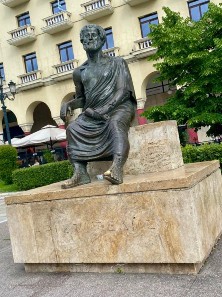
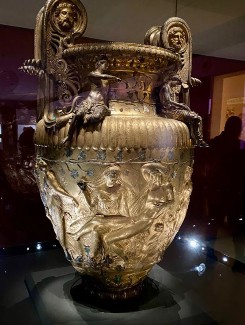
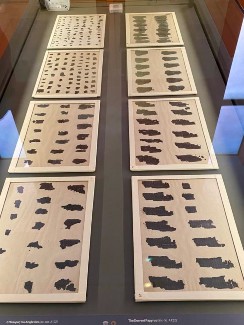
On our second day, I led my husband on a jam-packed walking tour of Thessaloniki; I wanted to squeeze in a much as possible, since I had a full itinerary to explore more further afield for the rest of the trip. Up first was the Archaeological Museum of Thessaloniki, one of the largest museums in the country and the central museum of Northern Greece. Its immense collection covers the history of Macedonia from Prehistory until Late Antiquity. I could easily dedicate this entire blog to all the thrilling pieces that we saw (but I fear that Sarah might already want to enforce strict word limits to my future blogs!), but some of the more notable artefacts include the Derveni Crater, an incredibly sophisticated example of 4th century BC metalworking. It used as a depository urn for the deceased’s ashes in one of the Derveni Tombs, and its gold hue derives from its physical composition: bronze and a large quantity of tin. Its elaborate decorations constitute a hymn to Dionysus and the main side of the vessel depicts his wedding to Ariadne. Likewise, seeing the carbonised remnants of the Derveni Papyrus, found on top of the covering slabs of one of the Tombs, actually gave me goosebumps. The main part of the text consists of a prose allegorical-philosophical interpretation of a theogonic poem, written in dactylic hexameters and ascribed in antiquity to the mythical poet Orpheus (it was likely written by the Athenian, Euthyphron, a contemporary of Socrates, who is known from the work of Plato); it’s an invaluable ancient text – its often referred to as the oldest European ‘book’ – that offers a glimpse into ancient Greek philosophical and religious thought.
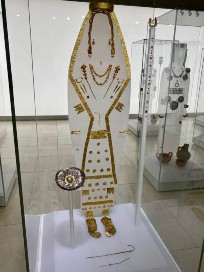
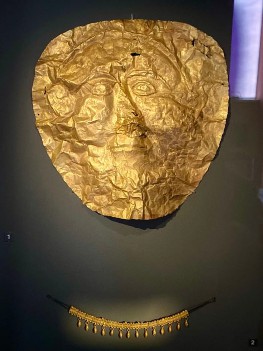 The final example is Gold Death Mask from the cemetery of Sindos (which contained over a hundred and twenty graves); while men were buried with their weapons and armour, this Mask belonged to a female grave from about 510 BC, and thus singled out the deceased as a very distinguished person.
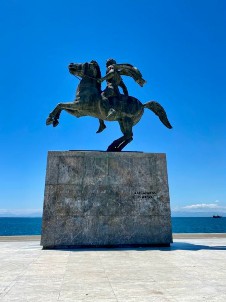
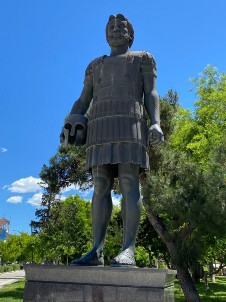
From the Museum, we walked to the Monument of Alexander the Great and Bucephalus. The duo dominates Thessaloniki’s Nea Paralia, and has been (understandably) one of the city’s most photographed sights since it was unveiled in 1974. Less than 5-mins away, and with considerably fewer tourists vying for the most instagrammable picture, stands the Monument of Philip II. A bigger draw – shame on them! – is certainly the White Tower, which is located just across the road from Philip’s statue. Built in the 15th century, the Tower became a prison under the Ottomans, it is now a museum and iconic landmark for visitors to Thessaloniki.
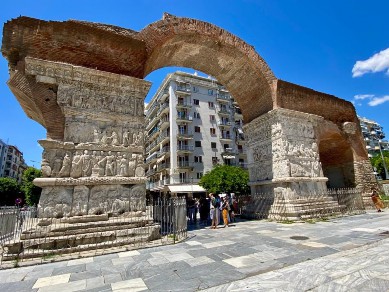
Leaving the waterfront and heading back to the urban heart of Thessaloniki, we went next to the Palace of Galerius. Galerius chose Thessaloniki as the eastern capital of his empire, and this required a massive building project: including the Palace, Basilica, baths, Octagon, and Aspidal Hall. Though the Palace complex and the Apsidal Hall were both closed on the Monday that we visited, much of the remains of the Palace complex can be seen from perimeter fence. The nearby Arch of Galerius is much better preserved than the Palace remains; it was built in honour of the victorious emperor when he returned to Thessaloniki (around AD 306) after the wars against the Persians. It’s now one of the few remaining examples of Roman imperial relief art in Greece.
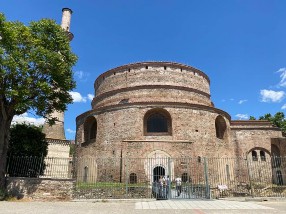
The Church of Agios Georgios – know more widely as the Rotunda – is located close by to the Arch. Built around AD 300, it was originally part of the imperial complex, mostly likely as a temple dedicated either to the Cabeiroi (chthonic deities) or to Zeus. In its sixteen centuries of existence, it transformed from a pagan monument to a Christian church, and then to into a mosque. In spite of the continuous changes in its use, the monument always kept its characteristic circular shape.
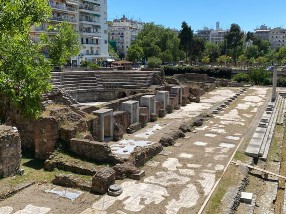
Unfortunately for us (well me, I suppose, as my husband was happy enough to have one less museum to visit!) the Museum of Ancient Agora was closed due to ongoing renovation works. And so we decided to explore the nearby Basilica of Agios Dimitrios. Because of his status as patron saint of Thessaloniki, this Basilica is perhaps the most important early Christian monument in the city; according to tradition, Agios Dimitrios was imprisoned at the Roman bath house and martyred with a spear in AD 303, and a small church was built over the saint’s tomb. Centuries of renovations and rebuilds ensured the status of the Basilica remained important pilgrimage centre throughout the Byzantine Period, and Christian worship was still permitted in a small area of the building even when it was converted to a mosque under the Turkish occupation.. Now, visitors can descend the stairs that leads to the underground Crypt of the Basilica, part of the original Roman baths. There is a small exhibition dedicated to the worship of the saint and the history of the church is on display. It mainly includes Byzantine pottery, sculptures, coins, and inscriptions.
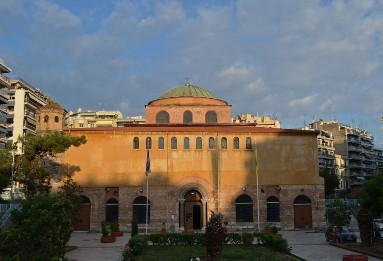
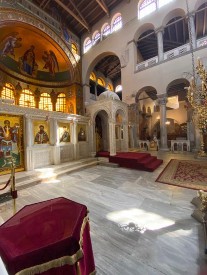
Our final stop was the Church of Agia Sophia, , which served as the metropolitan church of Thessaloniki throughout much of its history. Based on its architecture and decoration, the building was probably erected during the third quarter of the 8th century AD, and replaced an earlier church dedicated to Agios Markos which was likely destroyed by the great earthquake of AD 618 and the fire that followed. The present-day Church bears the shape of a Greek cross with a dome on top; the tower on the northwestern corner was a Turkish addition.
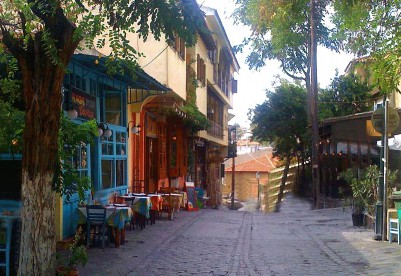
That evening, we walked to Ano Poli – Thessaloniki’s ‘city above the city’ to have something to eat. We stopped at Tsinari, a charming part of the Ano Poli, with a more traditional vibe. The few tavernas there quickly filled with tourists and locals alike as we finished our meal and dragged our tired feet back to the hotel.
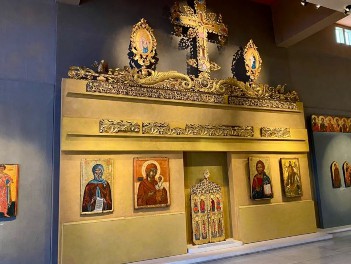
 After completing a full accommodation audit after breakfast, I rejoined my husband and we went to the Museum of Byzantine Culture. Within its eleven large galleries, all aspects of the Byzantine and post-Byzantine culture, with most artefacts from Thessaloniki itself. Moving from one room to another, the displays transition from late antiquity to Byzantium (icons, murals, mosaics, early Christian tombs, and artwork) and expound the consolidation of Christian culture, funerary practice, worship, and everyday life.
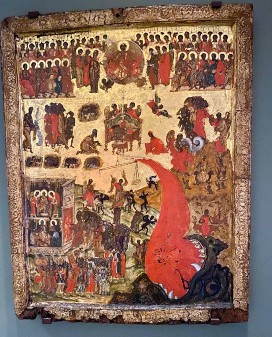
One icon that really stood out was the Last Judgement; there was so much to look at in the imagery but demons drifting the many sinners towards the mouth of Hades was hard to tear your eyes away from.
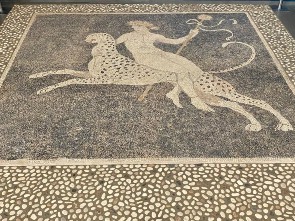
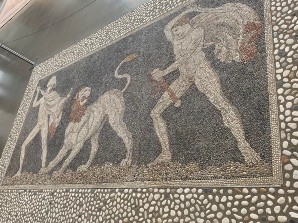
Afterwards, we set off from Thessaloniki towards Pella (approx. 50-mins drive by car), the capital of ancient Macedonia and the birthplace of both Philip II and his son Alexander the Great. We were keen for a coffee break, and opted to do the Museum first, rather than the site, and it worked out to be far better in this order. The Archaeological Museum of Pella (approx. a 20-mins walk from the site) has a magnificent collection on display; these are laid out in a number of distinct sections, featuring finds from private homes, public buildings, religious sites, tombs and the palace. For me – as with most other visitors, I imagine! – the elaborate mosaics were the most remarkable of all.
The Dionysus Mosaic, for example, was part of a pavement of the so-called Dionysus House (325-300 BC) and the details are exquisite. The scene has the god seated on the back of a panther; the god’s head, hands, and feet are delineated with lead wire, and white fired clay was used in the areas of his eyes and curls.
Moreover, the nearby Lion Hunt Mosaic depicts the moment when two huntsmen, one on either side of the lion, are about to strike the animal; it’s multiple colours (black, grey, white, and red) render it immediately striking, while capturing the movement of the lion moving forward but looking backwards, with his front paw stepping over the foot of the man drawing back his arm on the right.
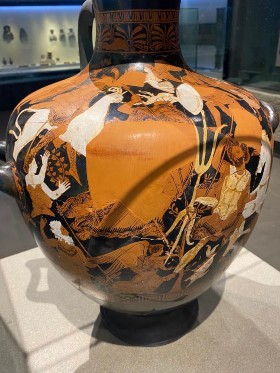
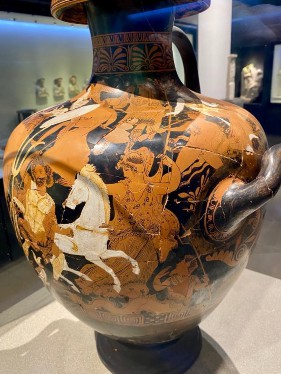
One final piece worth noting has to the red-figure Attic hydria (used as an urn in the cemetery of the agora at Pella) represents the contest between Athena and Poseidon for the honour of naming the city of Athens. Ascribed to the workshop of the Pronomos painter (late 5th-early 4th century BC), Nike is depicted as being about to crown Athena’s olive tree, with Zeus and his lightning bolt hovering nearby.
To be honest, I could have spent all day at the Museum but the next stop was a visit the Archaeological site for Pella (for which it’s necessary to purchase a separate ticket, FYI). Overall, the structure there might be a little underwhelming to those who have travelled extensively around other ancient sites– there’s little to see on the surface at the site, and the overgrown pathways made it trickier to navigate coherently – and there’s little archaeological remains to actually see on the ground. But for me, as a particular admirer of Alexander the Great (and, as my students would attest, an even bigger fangirl for Philip II!) the visit to the site was non-negotiable. And, I found it to be incredibly evocative; now, this may also have been due, in part, to the fact that my now-grumbling husband had opted to sit in the car with the air conditioning blasting (the late afternoon sun was relentless and the site has little shade), and that I actually had the site pretty much to myself. Visiting the Museum first certainly provides context for the subsequent site visit and would help visitors get a sense of its significance.
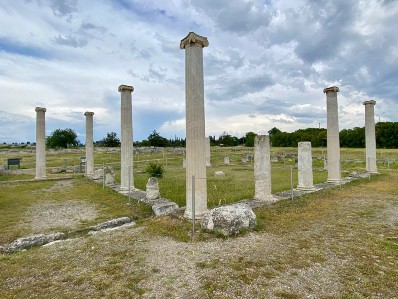
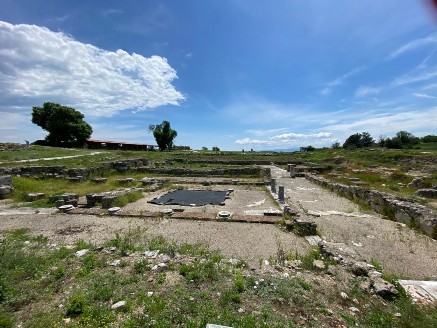
The site comprises of the agora, the impressive Dionysus House (the largest house in Pella) with its standing columns, other residences, Sanctuary of the Mother of the Gods and Aphrodite, public archives and baths, and potters’ quarters. The agora is particularly interesting; it was built in the last quarter of the 4th century BC – covering approximately 7 hectares, or 18 acres – but was likely destroyed in an earthquake in the 1st century BC, yet a wealth of finds from this specific area attest to its size and multiple uses in terms of manufacturing, administration, and commerce.
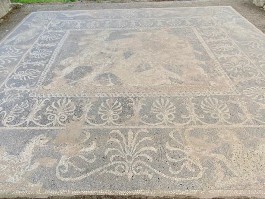
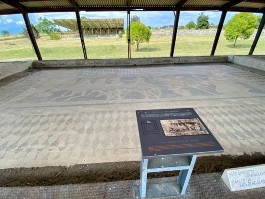
 But the main highlight must be the Helen House (325-300 BC); named for the in-situ mosaic depicting her abduction by Theseus, and another representing the 13
Amazonomachy. Both the sunshine and the roofed structures under which the mosaics are preserved made it more difficult to see the details of the pebbles – unlike the museum where the lighting was much better – but it was certainly a treat to view them in the context of the House itself.
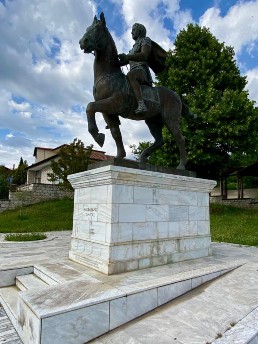
The Palace of Pella (approx. a 20-mins walk from the Museum) only opens at weekends – I could’ve cried! – so I only got to peek through the fence at it. There was further disappointment in that, as we drove into the centre of the modern town at Pella, there was nothing open (no shops or restaurants, not even a stall selling the usual touristic tat!). We did see some local roadworks in the area that might have been disruptive for visitors but, given how quiet both the museum and the site actually were that day, the eeriness of the town might have been due to lack of footfall. Still, it was worth passing through just to get a snap of the (yes, another!) Alexander and Bucephalus statue on the main square.
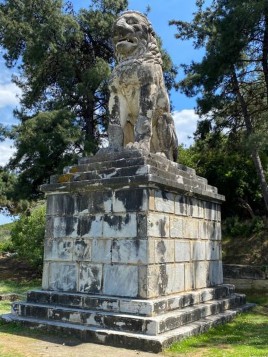
Day 4 was a busy one. Our first stop was Amphipolis (just over 60-mins drive from Thessaloniki) to visit both the site and Museum, and indeed the famous great Lion statue on the west bank of the Strymon river. The stunning Archaeological Museum of Amphipolis is home to a range of artifacts from the Athenian colony of Amphipolis and its surrounding area, essentially transitioning through the city’s Classical, Hellenistic, Roman and Early Byzantine (7th century AD) periods. Details about the archaeological finds are well-documented on the Museum walls and supported by frequent references to ancient literature; for example, information on the evidence of the wooden bridge that connected the city with its harbour – and the iron-cased wooden piles of which it was made – is pleasantly corroborated by a quote from Thucydides’ account of the Battle of Amphipolis (422 BC).
 I was delighted to finally see the Sphinx of Kastas, which was first unearthed in 2014; archaeologists found the intact head of one of the two sphinxes who guard the entrance of the Kasta Tomb (which dates to the last quarter of the 4th century BC). The marble head, slightly damaged on the nose, wears a polos and fine band on her head, while her curls falling on her left shoulder. Traces of a reddish colour still remain on the Sphinx’s head.
Across the road from the Museum, we explored the extensive site (currently free to visit) where excavations have uncovered considerable stretches of the city’s monumental walls, gymnasium, sanctuaries and a number of private buildings; the most impressive is the late Hellenistic dwelling with frescoes.
 The Lion of Amphipolis, a 4th century BC monument set up in honour of the admiral Laomedon from Lesbos (an important companion of Alexander the Great). Originally, the structure was made of limestone and sat atop a square base surrounded by a colonnade of Doric semi-columns; the anatomical details, such the veins on the Lion’s body, are astounding but the story of the initial discovery of some of its parts in 1912-1913 – with more found in the 1930s – give further weight to its symbolism and legendary status.
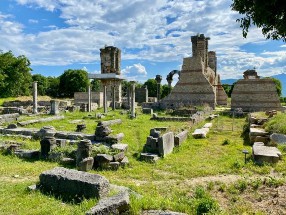
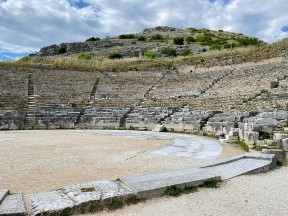
 Next up was Philippi (another 60-mins drive away), a UNESCO World Heritage site. The site itself was probably one of the busier spots that we visited on this trip, but it wasn’t heaving with tourists like major sites in Attica and the Peloponnese. The large site is characterised by three distinct layers of Hellenistic, Roman and Christian (Byzantine) occupation. Originally, just a colony founded 360 BC, Philip II conquered the city and named it after himself; he ultimately added a wall around the city and built an acropolis. One of the few elements still visible from Philip’s reign is the Theatre – the first structure after entering the site via the main gate – and which still dominates the area just below the acropolis. Originally built in the 4th century BC, most of what stands today is the result of Roman renovations (and the restored theatre is still used for the annual Philippi Festival that usually takes place in July-September). Augustus re-founded Philippi as a Roman colony, and he reshaped the Greek city with new public buildings, Forum, bath houses, temples, and even public toilets. The remnants of the existing Forum were built during the reign of Marcus Aurelius (AD 161-187), and visitors can walk around its huge open square surrounded by columns.
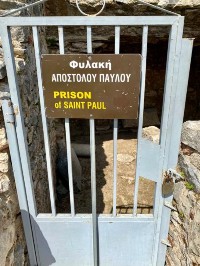
But most of the people exploring the site were taking pictures of one spot in particular: the the Apostle Paul’s ‘Prison’. St. Paul visited the city in around AD 49 and he baptized the first Europeans here and founded the first European Christian church in Philippi. The ‘Prison’ isn’t actually a prison at all, but an underground reservoir but the story of St. Paul’s public flogging and imprisonment at Philippi ensured that this spot became a place of worship and was decorated with frescoes.
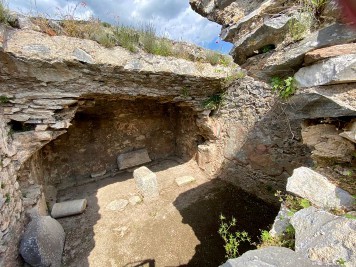
Without much shade on the site, I left my wilting husband at the café, beside the main entrance, with a lovely outdoor seating area (and a cooling misting fan) while I walked to the neat little Archaeological Museum of Philippi, situated at the edge of the site. The ground floor exhibits most of the historical and visual material (inscriptions, sculptures, vases, coins, and jewellery) of the city of Philippi and its region from the prehistoric period until the end of Roman antiquity. On the upper floor, there is a presentation of the Christian city (inscriptions, architectural pieces, and mosaics) from the Early Christian period, through the city’s decline in the 7th century AD, and up until its complete abandonment after the Turkish conquest of the late 14th century. The collection is not very large, but there are some splendid pieces:
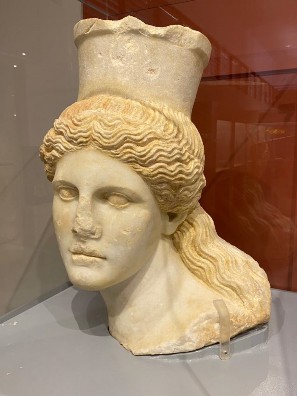
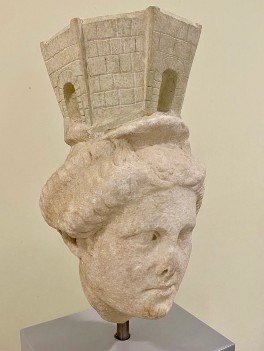
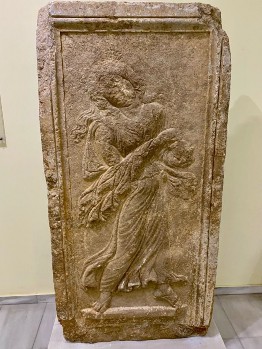
An unusual piece was the head of a priestess, connected to the Goddess of Luck of the City of Philippi (older studies claim this head belongs to the personified Goddess of Luck herself), with the crown representing the walls of the ancient city. It dates to period of years of Philippi being under the rule of the emperor Hadrian (AD 117-138). Another one that stuck with me was the Dancing Maenad from the portico of the stage building of the Roman Theatre (2nd century AD). She belongs to the followers of Dionysus; she is shown dancing feverishly with her hair loose about her shoulders, both her peplos and her cloak trail after her, and she carries a severed head in her hands.
The archaeological site of Aigai, its Tombs, and Palace is situated in the centre of modern Vergina (approximately 50-mins drive from Thessaloniki). First, we headed to the renowned Museum of the Royal Tombs, which is located within the town. On my bucket list for a very long time, I was ecstatic to be able to see Philip II’s tomb. The tomb itself was first discovered in 1977 and the subterranean Museum was built (in the early 1990s) directly over it to preserve them in-situ beneath the reconstructed Great Tumulus.
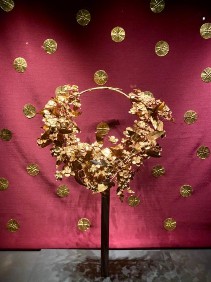
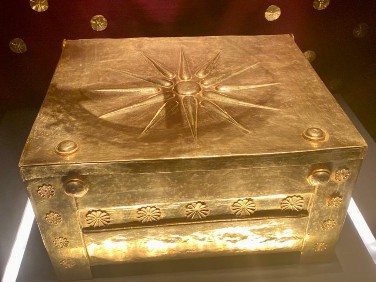
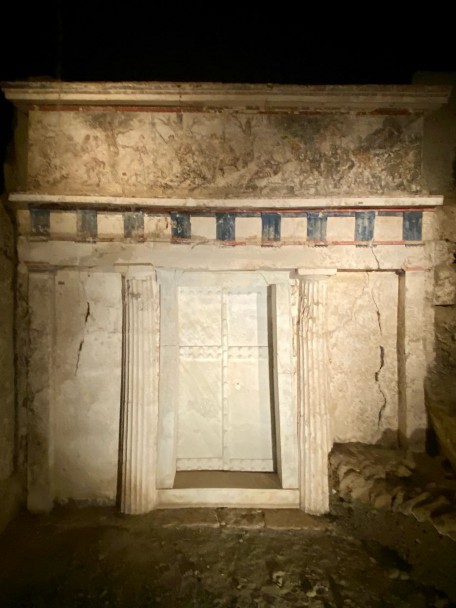 Inside the deliberately darkened corridors, we were dazzled by the wealth inside the royal tombs; gold material evidence is usually among the smaller collections of finds at most Greek museums but, here, there was extraordinary amount of bling at every turn. The gold gleamed from multiple display cases; examples like golden myrtle wreath of Philip II’s wife, that was laid on top of the gold and ivory couch of the antechamber, and the shimmering larnax (adorned with the star of Vergina) that contained the bones of the young royal wife, the Thracian princess Meda. I could list so many more pieces but it’s safe to say that the ostentatious display in Philip II’s tomb is nothing short of mesmerising!
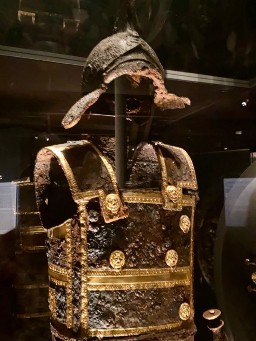
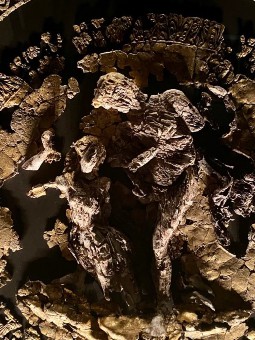
Philip’s suit of armour was also trimmed with gold; his iron helmet bore an embossed head of Athena, while golden lion heads button up the cuirass and stand as royal symbols. His shield, again embossed with lions and numerous Nikes on the interior, is exceptionally impressive on the exterior side: it was coated with gilded stucco in such a way that it seemed to be made of gold from top to bottom; at the centre, a gold and ivory representation of a Greek warrior vanquishing an Amazon likely depicts the tragic clash of Achilles and Penthesilea. These stunning treasures, alongside the finely crafted silver and bronze vessels, other weaponry and jewellery, vividly illustrate the opulence and craftsmanship of the ancient Macedonians.
After stopping for in the town for a refreshing pomegranate juice – I guess that means I’ll be back for another visit then, right? – we continued walking up the hill towards the Palace, visited the Theatre that was site of Philip II’s assassination in 336 BC. The Theatre of Aigai, one of the largest theatres of the Classical period, was abandoned in the mid-2nd century BC.
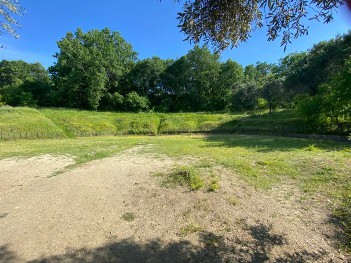
While the ticket for Polycentric Museum of Aigai officially includes the Central Museum Building, the Royal Tombs, the Theatre, and the Palace of Aigai, we were surprised to find that the solitary guardian on duty wasn’t interested in checking tickets; I expect that this will change in the near future, as new stations and facilities have been recently built close to both the Palace and the Theatre sites (and with a café/shop set to open beside the Theatre). Like at Pella, we were the only ones visiting that afternoon and, as such, we could enjoy the whole site to ourselves.
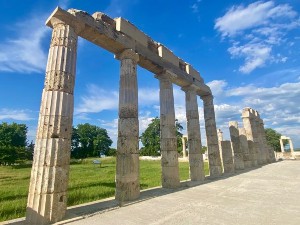
The Palace of Aigai is simply stunning. Built as part of Philip II’s great building programme, this basileion stands as the largest building of classical Greece – housing banqueting halls, a sanctuary to Heracles Patroos, a library/archive, and a palaestra – but it was destroyed in the middle of the 2nd century BC, after the Roman abolition of the kingdom. With ten columns on south and eleven on the north, the two stoas on the façade of the Palace were the first fully developed two-storey stoas in Greek architecture. Several of the palace’s massive Doric colonnades had been restored with a combination of original and replicated blocks, and some of the intricate mosaic floors also survived. The view was also wonderful; a vast portion of the Macedonian plain was visible from atop the hill.
For me, the Palace was my favourite visit of the entire trip (Philip’s Tomb was a close second …).
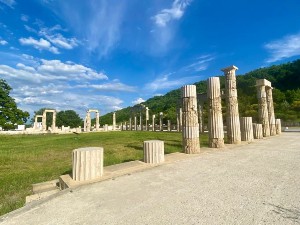
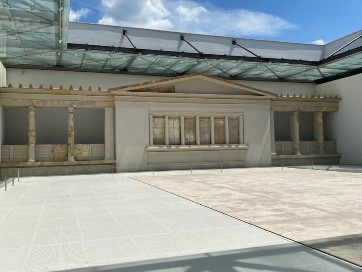
Lastly, we visited the Central Building of the Polycentric Museum of Aigai, which is located a short way out of town, (approximately a 5-mins drive away, along the main road). Inaugurated in December 2022, the Museum retains a fresh and contemporary vibe both in terms of its modern architecture and even more so in its display of artefacts. Unlike the atmospheric darkness of the Museum of the Royal Tombs, the Central Building offers an expansive light-filled space dedicated to the broader archaeological findings of the ancient city of Aigai. The display dedicated to the Queens of Macedon – in particular the golden grave goods and bridal veil of the ‘Lady of Aigai, the wife of Amyntas I, who died at the beginning of the 5th century BC – were especially dazzling. This Museum was truly a sensory overload.
If all of that wasn’t enough, we decided to finish off the day with a visit to Mieza (approximately a 40-mins drive from Vergina); specifically, the School of Aristotle, the idyllic, park-like area – surrounded by lush vegetation and flowing springs – where the young Alexander was tutored by Aristotle. With some help from Plutarch (Life of Alexander, 7.4) to set the scene, I got goosebumps visualising Alexander and his companions walking on the grassy terrace to take their seats on the stone benches carved along its sides.
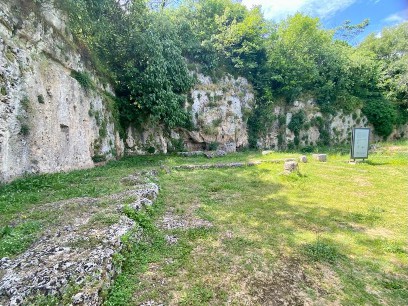 The site, also known as the Nymphaeum, is also home to numerous small caves, thereby making it an ideal place of worship for the Nymphs; originally used as a stone quarry in the 4th century BC, it seems clear that the site had become a sanctuary dedicated to the Nymphs in the later decades, with the addition of a portico and monumental gabled entrances to the caves.
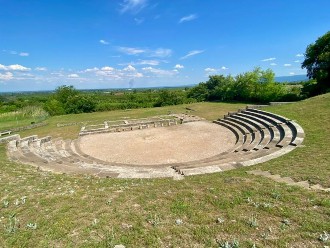
While in this area, I couldn’t pass on the opportunity to visit the Theatre of Mieza. Archaeological research has produced three distinct phases in its construction, and the earliest dates from the late Classical/early Hellenistic period. After the middle of the 2nd century BC, a new Theatre with a stone stage was built, but it was likely smaller than the Hellenistic one; this version had partially collapsed after an earthquake by the 2nd century AD, but repairs were made to the stage and supporting walls added to the bedrock, keeping the Theatre in use until at least the 4th century AD. The Theatre’s current state remains impressive because the extensive restoration project that was completed in 2014.
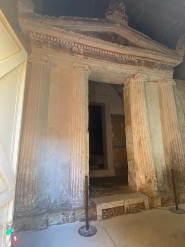
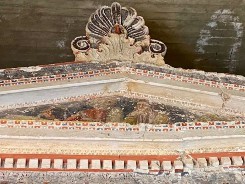
 Lastly, we visited the two Leykadia Tombs in the area, both dated to the early Hellenistic period; the so-called Tomb of Judgment, and the Tomb of Anthemia. Ranking amongst the largest Macedonian tombs yet to be discovered, the former takes its name from the spectacular fresco on its façade, a scene that depicts a Macedonian soldier being escorted by Hermes Psychopompus to face Aeacus and Rhadamanthus, two of the three judges of the Underworld. The sole depiction of this subject that we know of in ancient art, it refers to the scene in Plato’s Gorgias where Zeus describes appointing his three sons – Minos is missing from this depiction.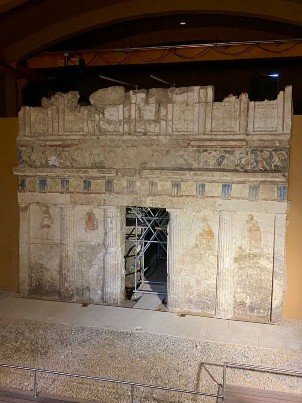
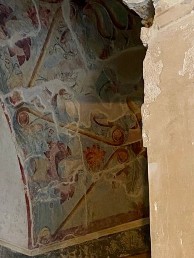
Normally, only the Tomb of Judgment is open for visitors but the guardian at the site very kindly offered to take us the short walk away to the locked Tomb of Anthemia. Also known as the Tomb of Palmettes, it was named for the flower that features prominently in its artistic design. It was built, like the Tomb of Judgement along the ancient road that connected Mieza with Pella. On the pediment’s tympanon, there is a painting representing a mature couple on a banqueting couch, and equally striking is the fresco on the ceiling of the antechamber with floral branches and water flowers.
After an early morning hotel audit on Day 6, we drove to Dion (approximately a 60-mins drive from Thessaloniki). One of the features that makes Dion stand out most from other archaeological sites is its proximity to Mount Olympus and the natural beauty of the grounds in which the ancient remains stand. Many people visit Dion as much for the flora and fauna there (maybe not the mosquitoes though) as for the archaeology. For me, it was a necessary inclusion on our trip because Dion was home to the temple of Zeus where Alexander the Great made a sacrifice before departing for Asia.
Lots of school groups here when we arrived but the vast size of the Archaeological Park (spanning a total of 150 hectares, or 1,500 acres) meant that it didn’t feel busy or indeed crowded. Dion is most noteworthy for its many Hellenistic and Roman sanctuaries: the Sanctuary of Demeter (the earliest Macedonian sanctuary known to date, from the late 6th century BC) Sanctuary of Isis (which is almost submerged in water as the site frequently floods), the Sanctuary of Asclepius, and the all-important Sanctuary of Zeus.
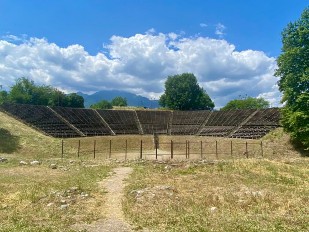
The Hellenistic Theatre is located to the west of the west of the temple of Demeter. It was built on the slope of a natural hill, and most likely dates to the reign of Philip V (221-179 BC); now only the hollow of the original construction is preserved. Research suggests that the Theatre was probably abandoned sometime after 168 BC after the structure started to degrade. Modern wooden seat were recently installed wooden for approximately 4.000 spectators and, every summer, the the Olympus Festival is held here. The Roman Theatre is located near to its Hellenistic counterpart, and dates from the 2nd century AD; it’s smaller and was built on flat land, but now only a few of the estimated twenty-four benches are currently preserved.
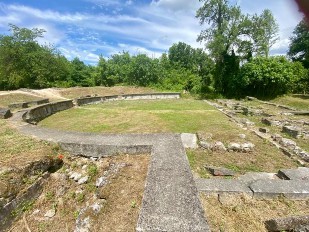
One of the most significant structures in the Park is the Villa of Dionysus. It was built around AD 200, behind a row of shops and workshops and next to a bath complex. The Villa has a courtyard with an ionic peristyle and a well that led to the tablinum. The most impressive room in the building is the squared banqueting hall, the floor of which was adorned with a multicoloured mosaic depicting the god Dionysus and thereby lending his name to structure.
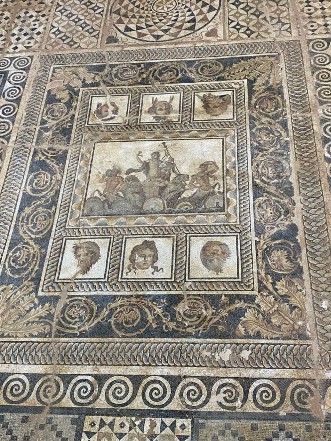 A short distance away, in the town of Dion itself, is the Archaeological Museum of Dion (for which it’s necessary to purchase a separate ticket to that of the Park). One of the two Museum building was purposely built to house the massive mosaic of the Triumph of Dionysius, which was only discovered in 1987 and fully restored in 2015. The mosaic depicts the god Dionysus in a commanding pose, riding in a chariot pulled by sea panthers; above and below this scene, theatrical masks are on display in honour of the god’s connection to drama. The contrasts between the colours in both the waves and in the mythical creatures is especially beautiful to see in person.
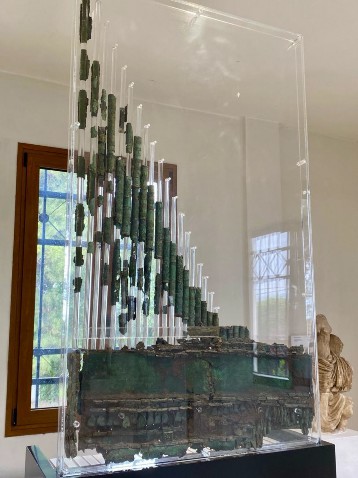
The second Museum building contains a lovely collection of the material evidence found at Dion and a few other sites around Mount Olympus. One of the most striking artefacts was the Hydraulis of Dion, discovered in 1992 by archaeologists working on the inside of a 2nd century AD building that they believed to be a metal/stone workshop. The rows of bronze pipes and plaques assured them that they had uncovered a musical instrument known as a hydraulis, but one which was constructed in the 1st century BC. It stands as the first such instrument discovered in Greece, and the oldest example ever discovered. A forerunner of the church organ, it’s remarkably similar to the reconstruction that we saw on display in the NOESIS Science Centre & Technology Museum.
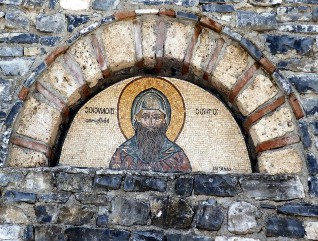
 When driving to Dion and indeed walking around the Archaeological Park, the connection Mount Olympus was ever present. After the Museum, we opted for a closer look. Olympus is the highest mountain in Greece at 2,918 metres (9,573 feet) and its location – so close to the Aegean Sea – gives it a unique climate that often leaves the peak shrouded in clouds and frequented by storms. On our drive along the winding roads up towards the Holy Cave of Agios Dionysios, we experienced this firsthand. Just as we set of on foot to find the Holy Cave (where the saint lived as a hermit ever since his arrival at the mountain in 1542), Zeus mocked our lack of preparation with relentless downpours – Dion had been lovely and sunny, and so coats and the all-important-umbrella had be relegated to the car boot – mere minutes into our little hike to find the Cave. The trees and foliage on either side of the dirt path that we were following did nothing to shelter us from his divine derision and – I’m sorry to say – we had to abandon our mission and retreat back to the car. We had a little more luck with the nearby Old Agios Dionysios Monastery, and managed to take a brief walk around the crumbling site of the original 16th-century fortress-like structure – which was destroyed by the German troops in 1943. Built at an altitude of 900 metres, and devoted to the 29
Holy Trinity, it appears that some restoration works are being carried out to preserve the site but it does resemble a building site in places as a result. Even though this part of the trip had been a bit of a washout, the views up and down the slopes of Olympus were entirely worth it – and I only rolled my eyes once when the clear skies returned as soon as we were back at base level.
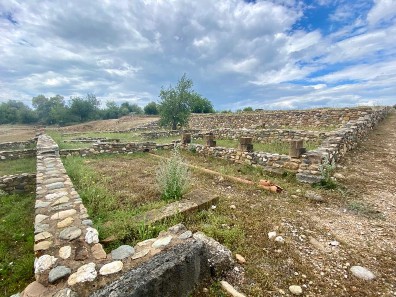
On our penultimate day in northern Greece, I had one final stop planned on our itinerary, and that was Olynthus (approximately a 60-mins drive from Thessaloniki). The remains at the site of Olynthus provide a unique chance to wander through the residential streets of a classical Greek city; indeed, the foundations on the site offers the best evidence there is for Greek houses of the late fifth and early fourth century BC. It is clear to see from the grid-like remains that a large area of new housing had been deliberately planned in rectangular blocks, with wide parallel avenues intersected by vertical streets.
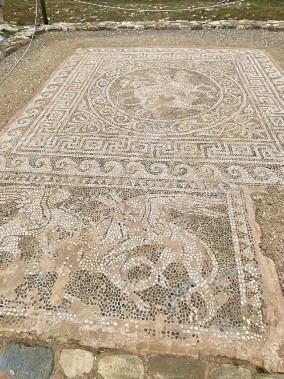
Some houses had beautiful mosaic floors, which stand among the oldest Macedonian examples dating from the late 5th to early 4th century BC. One example shows the Bellerophon on a galloping Pegasus, thrusting a spear at the Chimera; the black and white pebbles lend a dramatic flair to the aerial combat scene.
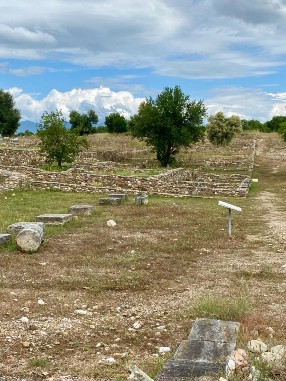
The site can be tricky to navigate as there are so few information boards; as such, advanced preparation is essential before visiting (or potentially consider hiring an archaeological guide). That being said, the tiny on-site Interactive Museum does a good job of escorting visitors on a virtual walk through the streets of Olynthus with its innovative digital exhibit. Using 3D reconstructions and augmented reality for the purposes of storytelling, it was an interesting way to add some context to the complex site. While we were there, children, teenagers, and adults alike watched the videos and explored the digital collection of the artefacts that were uncovered on the site.
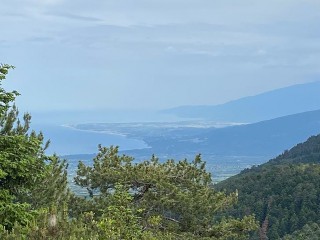
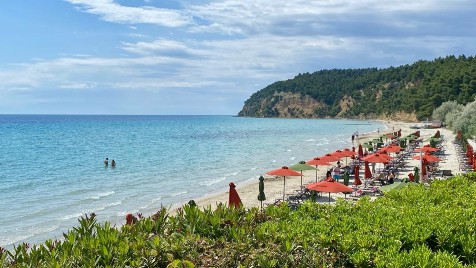
As a treat for our weary feet, we took the rest of the afternoon off and drove down to Kassandra peninsula of Chalkidiki; my husband didn’t require much persuading for this stop! We pulled in at Sani, a beautiful location close to Nea Fokea. With views like this, I couldn’t think of a better way to end our trip. 31
Our flight home was at midday and so we had little time to see anything else (and there were so many more places on my list!) on the last day, given that we had to return the hire car first. But I guess that only means that I have to go back again (right, Sarah?); I mean, I did drink the pomegranate juice …