

I am currently writing from poolside at Anya Hotel and Spa, Pamukkale, home of the famous Travertine basins and the Hellenistic city of Hierapolis, which I shall be visiting tomorrow, alongside the city of Laodike, before heading southwards to the final stop of my trip, Kalkan and the Lycian coast. Given I have packed so much in, it seems strange to think that I was in Bergama yesterday when I last wrote. Well what has happened / what have I seen since then?
It should be said first of all that modern-day Bergama is a proper, rural Turkish town, with very few touristic frills. This meant that, as far as I could find, there was only one restaurant – Acropole, at the top of the town, that served alcohol. It also meant that the first morning of Eid al Adha (yesterday) was a real cultural experience, as families were slaughtering and butchering sheep and goats in their own front yards. This is clearly a massive festival for the traditional Turkish rural population – all morning long, incredibly friendly villagers were asking me to join them in their sacrifices – well, not really asking, as none of them spoke English, but beckoning me over. I have to say, the endless bags of innards that littered the sides of the streets, and the streams of blood that were running down them, were quite something!
The start of this festival meant that the archaeological sites did not open until 13.00 – something neither Google nor my AI assistants foresaw, but thankfully my lovely host, Vedat of the charming Hotel Elaia, told me this straightaway, meaning that I did not set a totally pointless alarm! Anyone who has seen the sites of Ancient Pergamum – royal seat of the Hellenistic Attalid dynasty, and probably the pre-eminent city of Asia Minor during its time – will tell you that it is a sprawling metropolis, spread throughout the modern-day town, but the highlight is surely the acropolis, perched high on the hill above Bergama. Given my delayed start, and the fact that I needed to be in Selcuk that evening, I decided to skip the museum (for once!), and to see the red Roman basilica only from the road. Having had my fill of a wonderful breakfast prepared by my host Vedat and then of watching the morning’s sacrifices, I ensured that I was first in the queue when the ‘Asclepium’ – Bergama’s main lower archaeological site – opened its doors at 13.00. This site – a healing centre and sanctuary to the god of healing – had similar significance to its equivalent at Epidauros in antiquity, and I would suggest that an exploration of it is a somewhat similar experience to that of its mainland Greek counterpart – a very nice spot, but bar a rather well-preserved odeion (but not in the same league as Epidauros), relatively, not that much of note to see!
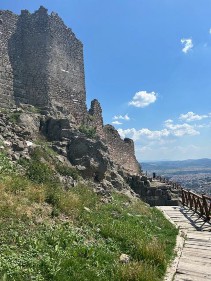
The Byzantine walls of Pergamum
As far as I’m aware, there is not a ‘Pergamum combine’ ticket that allows entrance to both the lower bit – the Asclepium – and the upper bit, the Acropolis, but – from memory – neither were particularly expensive. Anyway, having done the Asclepium, I headed back on foot to my car to drive up to the main event. I had initially planned to take the cable car, but my host had said that that would be a total waste of money. I also would not recommend walking it, as it is a long, steep ascent with very little protection from the sun. If you do drive, yet again, do not make the same mistake that I did in following the SatNav – you end up on some pretty hairy steep cobbled streets – instead skirt the hill on the main road. I would also suggest parking at the last car on the verge, rather than doing what I did in pushing on up the hill – thankfully, a car departed just as I was beginning to run out of options, giving me a dream spot – but had this not been the case, things might have got a little bit awkward!
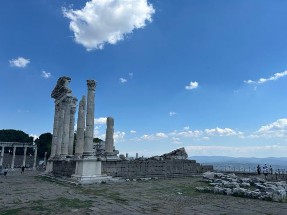
The ‘Trajaneum’ on the acropolis of Pergamum
Anyway, the site of the ancient acropolis of Pergamum itself is jaw-dropping. From the top, you have a 360-view over modern day Bergama and the wilderness of Western Anatolia. The ancient stuff there is also pretty cool. The highlight of it has to be the magnificently restored ‘Trajaneum’, a Roman temple built out of gleaming white marble and on a terrace cut into the hillside. Other stand-outs include the remarkably steep – and gigantic – Roman theatre (put it this way, I was not tempted to descend it!), and the city’s towering Byzantine walls. Given my time constraints, and the fact that it was a boiling hot afternoon, I decided not to descend to the lower agora, but I felt like I got a pretty good view of it – and indeed the ancient aqueduct – from the top!
And so I hit the road heading on to Selcuk, and what I knew from the beginning would be a real highlight of my trip, ancient Ephesus. Firstly, a word about Selcuk itself. Many of the guide-books that I had read in advance had lambasted it as a sell-out and overly touristy. I have to say this could not be further from my experience of it. Getting off the main thoroughfare, I found the wonderful Ejder restaurant for dinner – probably the best Adana kebab that I have had so far this trip (and that is saying quite a lot!) – and then a raki at a wonderful nearby bar. My hotel – Cella Hotel and Spa – was also a step up from those that I had stayed at up until then, though to my despair after a long day in the sun, and then in the car, its pool closes at the rather early time of 18.30.
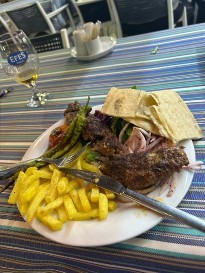
Adana kebab at Ejder restaurant in Selcuk – one of the best things I ate all trip!
Anyway, after a truly outstanding breakfast of freshly cooked Menemem (a cross between scrambled eggs and an omelette, with peppers folded in) at the above-mentioned hotel, I headed out this morning, thinking I would save the best – the ancient city itself – until last, doing the in-town ‘Basilica of St John’ and apparently very good Ephesus Museum first, and not to forget, what little remains of the original ancient wonder of Ephesus – the Temple of Artemis — indeed reckoned as one of the seven wonders of the ancient world.
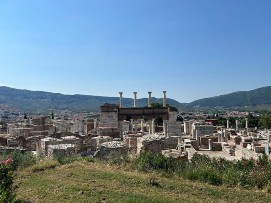
The Basilica of St John in Selcuk
The Basilica of St John is well worth it, built under the Byzantine emperor Justinian in the sixth century, at exactly the same time as the Hagia Sofia, reviewed in my Istanbul blog. It is built on an acropolis above Selcuk called Ayasuluk, which has been inhabited since Mycenaean times, and also features a rather impressive Byzantine-then-Ottoman castle. Conveniently timed to allow me to cool off after a bit of a hike up that hill, I then visited the very well-reviewed Ephesus Museum in town. Given that nothing from it has stuck in the mind, I would say that it is perhaps over-rated, but maybe, in my case it was over-shadowed by what followed it. Even though only one column of it stands, I would still highly recommend a visit to the Temple of Artemis, totally free and an opportunity to see one of the most famous temples of the ancient world. Even from the very limited remains of it, you can tell that it must have been gargantuan!
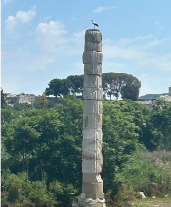
The one column that still stands of the Temple of Artemis at Ephesus – once one of the seven wonders of the ancient world, now a nesting spot for storks!
I then headed on to the main site of the Ephesus ruins themselves. On account of prior recommendation, I made sure that I purchased a ticket that included the terraced housing – something I certainly do not regret (see below!) One can purchase a combined ticket for 65 euros that includes everything mentioned, but I have not yet worked out where the saving is here – put it this way, if there is a gain, it is minimal!
Ancient Ephesus itself is simply jaw-dropping. It had been built up to me in advance of the trip by several sources, and it did not fail to deliver. In fact, it may now be my favourite site of the (post-Mycenaean!) ancient world.
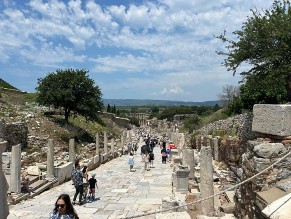
The ‘Arcadian Way’ – the main thoroughfare through Ephesus.
What I love about it: the fact that it is so vast, and so well preserved, but lacks the sprawling nature of Pompeii. Basically, if you give yourself enough time to walk slowly round it, you will not miss anything at Ephesus. I am happy with the way I did it, and would recommend it: start at the south gate walking downhill to allow you to enjoy all the wonders of it feeling fresh, and then take your time reviewing the other bits, and stopping at the immersive museum (see below), and the terraced housing on the uphill way back. Iconic features such as the library of Celsus, the ‘Arcadian Way’ (the great marbled street that runs through the middle of the city), and the vast theatre, more than live up to their storied billing for real.
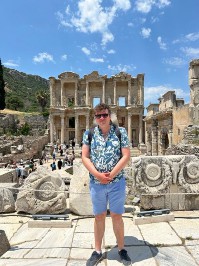
The author in front of the wonderfully restored Library of Celsus.
I want to put a brief word in here for the on-site immersive museum, which in one of my guidebooks was dismissed as ‘not worth it’. For one thing, entry to this museum seemed to be included as part of the general admission ticket to the site, and for another, I feel like it gave the viewer a wonderful idea of what Hellenistic Greek and Roman Ephesus would have been like – through excellent music, graphics and storytelling. Not to mention the fact that it gives its viewer a brief bit of air-conditioned respite from the sweltering heat of totally exposed Ephesus! Entry to the covered terraced housing was also well worth whatever I paid for it. Put it this way – this alone would be the most significant Roman site in the UK. The walkway that takes the viewer above several blocks of insulae is brilliantly designed, and I would describe the whole thing as Pompeii-esque in its illustration of Roman city life.
So that was Ephesus – absolutely fantastic!
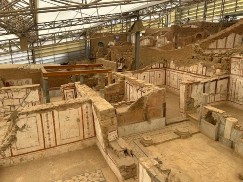
The terraced housing at Ephesus – well worth the additional fee!
And, now, from the Travertine basins of Pamukkale,
Time for an Efes!
Big fan of:
Ephesus immersive museum – badly reviewed, but in my opinion, excellent!
All of the following:
Elaia hotel, Bergama
Cella hotel, Selcuk
Ejder restaurant, Selcuk
Not such a big fan of:
Ephesus archaeological museum in Selcuk – I can’t remember any of this!