

I write this, the final blog of my 8-day Turkey adventure from Istanbul to the Lycian coast, on the streets of that famous tourist hotspot of Kalkan, enjoying, it must be admitted, a bit of a final ‘Brit abroad’ evening, watching the Champions League final with an Efes!
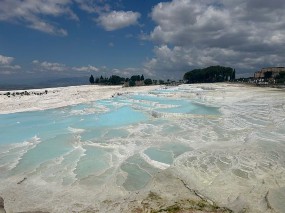
The beautiful Travertine terraces of Pamukkale
I last wrote as I pulled into Hotel Anya beneath the dazzling travertine terraces of Pamukkale. If you haven’t seen them before, these are gleaming white limestone cliffs that sit above the village, at the top of which is the sprawling Hellenistic / Roman city of Hierapolis. Having enjoyed another lovely authentic Turkish meal at ‘Mom Eve’s’, in which son waits tables while (presumably eponymous) mum and grandmother cook, I got a good night’s sleep, before heading to the south gate of the site for an early entry at 9AM (the same gate serves both the terraces and the site at the top). Up until then I had not really encountered a queue worth its name on the trip, but here for the first time, I needed to queue for about 30 minutes before getting in. I was definitely right to get there early; by the time I departed that afternoon the queue looked nearer the hour-long region.
Anyway, ascending the travertines is quite the experience, something that no guidebook can really prepare you for, but it should come with a couple of warnings. In order (rightly) to protect their iconic gleaming white shimmer, you are not allowed to walk them in shoes – and not all of the ascent is smooth – indeed ascending some of it is quite a painful experience. The ascent is also busy, narrow, slippery and steep, but not dangerous if taken slowly – just not for those who like to stay on terra firmissima! As you go, you can paddle in the first rank of the basins, which get an ever-more heavenly shade of blue as you get further up.
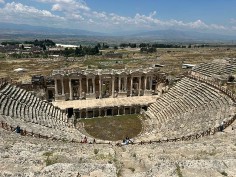
The theatre at Hierapolis.
Once at the top, you get a wonderful view over the best of the basins, before you can turn to enjoy the vast site of Hierapolis. This is your classic Hellenistic / Roman metropolis, featuring a wonderful theatre, and all sorts of agorae, stoae and religious buildings. There is also a very decent museum with a particularly fine collection of sarcophagi. One thing to bear in mind when visiting this site is that, because of the ‘insta-worthy’ terraces, it gets extremely busy – indeed it was busier than Ephesus – and on account of this, queues at the kiosks are long. So bring enough of your own water – for the first time on my trip, I had to go waterless for a pretty hot and sweaty hour! One can pay an extra fee (not much – about 10 euros) to swim in the ancient, naturally heated ‘Pool of Cleopatra’, which I did, and would say is just about worth it as a one-off experience! Bear in mind also that what goes up must come down; if you park at the south gate (as I did), you have to de-shoe and descend the travertines, which, by this time for me yesterday – thirsty and with sore feet – had somewhat lost their initial wonder. If one is more interested in the archaeology than the travertines, I would suggest they consider entering the site at the north gate.
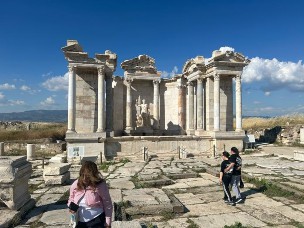
The Trajanic ‘nymphaeum’ at Laodikeia on the Lycus – a site that I strongly recommend for its awesome scenery!
On the recommendation of a guidebook, and given the nature of my trip, I had purchased a 40 euro combined ticket for Hierapolis and Laodikeia on the Lycus, an ancient city some 10 miles south, perched in the foothills of the Taurus mountains. I have to say that, having spent five sweaty hours in Pamukkale / Hierapolis, and with a three-and-a-half hour drive down to Kalkan needed that evening, there was part of me thinking at 3PM yesterday that I would cut my losses here. But I did not, and how happy am I that this was the case. This site stands as the polar opposite to Hierapolis. Whereas Hierapolis is touristy, crowded and perhaps over-rated, this site is stunning, natural and – when I did it – pretty much empty. I suggest that you visit it more to experience the raw beauty of the landscape than any particular ancient feature of it, but it does have a wonderful, atmospheric theatre carved into the hillside, a magnificent ‘nymphaeum’ with a brilliantly preserved statue of Trajan, and a Byzantine church that commemorates the fact that St Paul visited there. I have to say, it was quite special to walk such a naturally beautiful site, and be pretty much the only person there!
After my initial scepticism, I ended up far exceeding the 1 hr limit that I had set myself to view the site, but eventually had to remind myself that I had one of my longest drives of the trip – down to Kalkan on the Lycian coast – still to do. This
drive, which takes you straight through the Taurus mountains, is stunning, but at times a little hairy – not due to the quality of the roads, which are fine, but due to the approach of the rural Turkish to driving – road markings seemingly mean absolutely nothing to them!
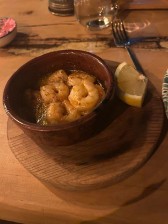
Delicious garlic prawns at Eski Ev, Kalkan!
Anyway, at about 9PM last night, I checked myself into the extremely well-located ‘Old Town Hotel’, and quickly set about making up for lost time, enjoying the culinary delights of the authentically Turkish rooftop restaurant of Eski Ev– to such an extent that I may return tonight – and then finding out which rooftop cocktail bar served the best mojito!
Part of my reason for staying in Kalkan was to ensure that I had a fun ending to my trip, but an equal part of it was to see the Lycian sites of Xanthus, Letoon and Patara. After a slightly later start than what I have been doing so far (I wonder why this was?!?), I set out this morning into the field for the final time, on the short drive from Kalkan to the capital of the ancient kingdom of Lycia, Xanthos. I had been pre-warned by all my guidebooks not to expect to be able to see too much here, but there is plenty for one to get their teeth into, with a very easily accessed Classical Greek and Roman town, and a much harder-to-access Lycian-cum-Hellenistic city on the acropolis.
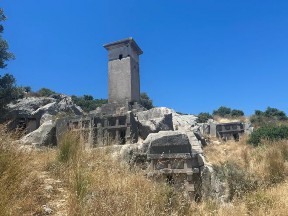
The ‘Harpy Monument’ at Xanthos, a site that it is in need of a little TLC!
Feeling intrepid, I attempted to navigate my way through the undergrowth to get there, and after plenty of snapping foliage and scrabbling over rocks, I made it to the top – something that was well worth it, both to see the ancient Lycian walls and the famous ‘Harpy Monument’, a majestic tomb that is inscribed with the undeciphered ancient language of the Lycians. Whoever is in charge of the site simply must tidy it up and make sure this important bit of it is made more accessible!
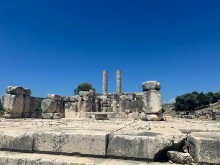
The temple of Leto at Letoon.
From the city of Xanthos, I headed across the river from which it derives its name to Letoon, a sanctuary to Leto and her twin offspring Apollo and Artemis. This site has an unusual feature, in that, due to how low it is, much of it is flooded, including the orchestra of the theatre, which is now used as a gigantic trough
for the flock of sheep that reside there! The highlight of this site is undoubtedly the trio of temples, with the magnificently well-preserved temple to Leto alongside ones dedicated to each of her offspring. Having forked out quite a lot on entry fees this week, it was refreshing not to have to pay a penny for either Xanthos or the Letoon. Whether this was by chance (they both did have unused ticket offices) or the norm now, I do not know!
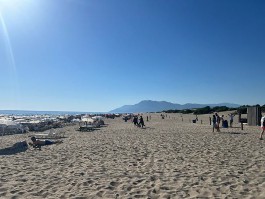
The 18 km-long Patara Beach, a great place to cool off after seeing the ancient site!
My final archaeological stop of the trip was the beautifully preserved city of Patara, located conveniently above the longest beach in Turkey (of 18km!) This Hellenistic / Roman city stands in stark contrast to the aforementioned sites, as on account of its location, it has been very well protected by the Turkish government, and charges quite a steep entry fee! But of course, as part of this, you get prime access to the best of Patara beach, which for me was a wonderful way to end my holiday – a trip that has been a genuinely inspiring experience for me. Buoyed by positive spirit, I’m now hoping that Arsenal win Champions League final, but regardless, am going to make sure I enjoy my final night overall – not before, however, I pay my dues and list some of my true ‘superstars’ of the entire trip:
The restaurants: I have come to the conclusion that all Turkish food is outstanding. Full stop. But the culinary highlights of my trip have been Ejder, Selcuk (authentic backstreet Turkish stuff), and Eski Ev, a wonderful rooftop restaurant in Kalkan which probably served me my best meal of the trip – garlic prawns followed by delicious beef skewers – so good in fact that I may go there again tonight!
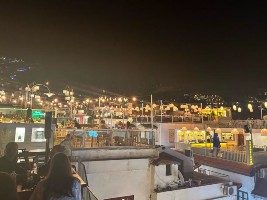
The rooftop terraces of Kalkan.
The hotels: Put simply, Ayasultan (Istanbul), Helen (Canakkale), Elaia (Bergama), Cella (Selcuk), Anya (Pamukkale) and Old Town (Kalkan) were all ideally located for my purposes, and all perfectly decent hotels with absolutely nothing to complain about. Other than Old Town, the rest provided wonderful included Turkish breakfasts. Cella perhaps the nicest of the bunch.
Heroes of the trip:
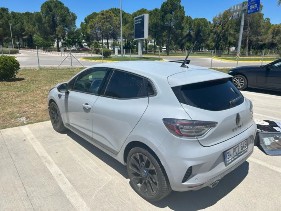
My trusty companion throughout my adventure!
My hired Renault Clio, automatic with all the gismos – an absolutely faultless and easy car to drive, even for someone who is not renowned at all for their ability behind the wheel.
The Blue Guide – I had armed myself with all sorts of guidebooks for my trip, but this is simply the best for archaeology and culture.
My M&S ‘explorers’ hat given to me for my birthday by my brother – light, comfortable and keeps the sun out!
– The audiobook of Emily Wilson’s Iliad – I only have book 24 to go, which should see me through my drive to Dalaman airport. Listening to this has made for some extremely atmospheric drives across the landscape that inspired Homer!
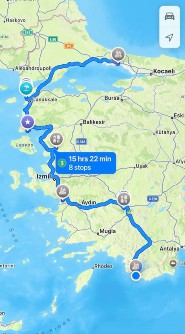 I hate to say it, but ChatGPT, for its on the whole very good recommendations, and even being able to have an accurate guess at which lump of rock I might be looking at!
And finally, the self-explanatory, ever-present, ubiquitous Efes beer!
And on that note…