

I am writing this in the wonderful surroundings of Gülhane Park, propped at the foot of one of the many towering poplars standing there, much in need of a ‘chill’, having accomplished some 30,000 steps today.
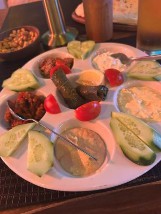
My meal on the first night!
I arrived at this extraordinary city late last night, after my flight was delayed, but quickly set about making up for lost time in assessing whether there was veracity behind the legendary hospitality of the Turks. Any concerns of whether I might get a meal – or even just a drink – at that late hour were short-lived, as I stepped out of my (very conveniently located) Ayasultan Hotel, and was immediately accosted by patron after patron trying to tempt me with each of their particular versions of the classic Turkish kebab and mezze menu.
Trying to abide by at least some basic principles of being a savvy tourist, I ensured that I went one street off the main thoroughfare, and ended up in the fun- but-not-too-touristy-looking ‘Amara Garden’. Not wishing to push the boat out too far on the first night, I ordered – yes, you guessed it! – cold mezze platter followed by a lamb kebab – all of which was as delicious as I hoped it would be, particularly when washed down by several glasses of that wonderful Turkish beer, Efes. Whilst a sore throat did not allow me to follow the locals in partaking in the customary shisha pipe smoking, I did have my first drop of the preferred local spirit – raki – a grape liqueur flavoured with aniseed, which I have to say, when mixed with plenty of water to form the cloudy aslan sutu (‘lion’s milk’), as the Turks call it, was delicious!
Whilst tourism is obviously an essential element of the Turkish economy, and therefore Turks are going to sell things hard, from just one night here so far, I can tell that they are going to be great hosts. I also got my first impression of the (perhaps unique?) cultural status that this part of Turkey holds, as one that is both deeply committed to Islam and yet also very ‘Western’ in attitude. On the table next to me were a young couple enjoying a meal out – he smoking and drinking his way through the night, she, in full hijab, rather more reserved – but clearly enjoying herself!
In advance of my adventure, I had watched an excellent Simon Reeve documentary on Turkey, produced in 2017, in which Reeve does a deep dive into the cultural shift that has happened in the country under their now more-than-decade-long President, Recep Erdogan, highlighting how his long-serving President had used a more visible national alignment with Islam as a means of uniting the country (behind him).
Some of this was undoubtedly apparent in my first day of sightseeing, which took in the historic zone of the European side of Istanbul. Being a Classicist first and foremost, I could not really start anywhere other than the Roman hippodrome, off which seemingly all of Istanbul’s historic wonders stand. This site – totally free – is completely awesome. Three obelisks that would have once decorated the spina – the bit around which the chariots would have raced – still stand to this day, and make it very easy to envisage this as the central hub of Byzantine Constantinople, used not just for racing, but also for imperial triumphs and the burning of heretics!
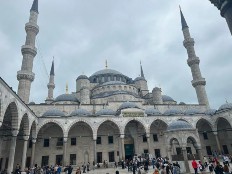
The Blue Mosque
Looming over the Roman hippodrome, with its wonderful domes and spires, is the gift of the early seventeenth century Ottoman Sultan, Ahmet I, to Istanbul, the Sultan Ahmet Camii (or ‘Blue Mosque’). Unlike the Hagia Sofia (see below), this building has never been anything other than a fully functioning mosque – something, to my shame, I had never actually set foot inside, but now was the time. I was surprised to see how plain the interior of this externally stunning building was. Coming from a Christian background, a religion which perhaps has a tendency to downplay the religiosity of its own architectural wonders, I was also surprised to see so much literature available – both on pamphlets and billboards – selling the merits of Islam to the visitors of the mosque. Whether this has always been the case, or is in line with that recent shift of attitude that Turkey has undergone, I do not know, but will perhaps find out over the course of this trip!
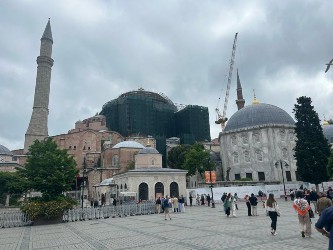
Hagia Sofia
Just down from the Blue Mosque is that jewel of Constantinople, the Hagia Sofia, commissioned by the Emperor Justinian in 532. If you are going to pick a place that encapsulates the varied past of Istanbul, this is it: for some one thousand years, it was the principal church of Greek Orthodox Christianity, then for the next five hundred years, a mosque under the Ottomans, then from 1932 to 2020, a museum, and now, since then, a mosque again. This tension is apparent both in the viewer experience and in the interior of the mosque. Non-Muslims are required to stick to the upper gallery, as the interior is reserved for believers to pray. When Mehmet II captured the city in 1453, he declared brutal, tragic destruction upon many of the Christian artistic jewels that resided within the mosque, and all of the Byzantine mosaics were subsequently painted over during Ottoman rule, but thankfully, due to the heroic work of the Byzantine Society in the twentieth century, some of these have been restored. The very fact that the mosque now hosts a blend of Muslim worshippers, and then Christians and historians of art paying a considerable ticket price to see these jewels of the Byzantine era, and the two groups never crossing paths, encapsulates the somewhat uneasy relationship that Islamic Istanbul has with its Byzantine Christian past, but should perhaps be celebrated as an example of different cultural histories co-existing, and respecting one another.
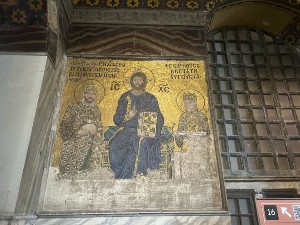
The eleventh century ‘Empress Zoe’ Mosaic
There is no such tension apparent in the viewer experience, or history, of the simply wonderful ‘Basilica Cistern’, the monumental underground water-storage system, built in the reign of the sixth-century Byzantine emperor Justinian I. This masterpiece of Byzantine architecture, which was designed to resolve the issue of the city’s lack of running water supply, was totally unsurprisingly used by the Ottoman invaders for exactly the same purpose for over one-thousand years!
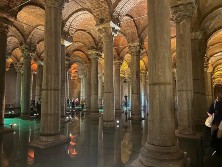
The wonderful ‘Basilica Cistern’
After an excellent lunch of prawns from the sea of Marmara, my afternoon was spent exploring the vast expanse of the palatial seat of Istanbul’s Ottoman Sultans, the ‘Topkapi’ Palace. Once again, this tension between Istanbul’s Ottoman and Byzantine legacy was apparent. Within the grounds of the palace is a jewel of Byzantine architecture, the sixth-century Hagia Eirene (‘Church of Divine Peace’). The relative modesty of this ancient church stands in stark contrast with the luxurious seat of the sultans, which, despite being an expensive viewing (see below), is worth it. Not being particularly clued up on the Ottomans, I was stunned to explore the Harem quarter, where up until the early twentieth century, the wives of the sultan were guarded and attended to by black eunuchs, themselves victims of the slave trade. Nevertheless, it was also fascinating to read of the special place in the community held by the last generation of these eunuchs, and the extraordinary stories of their lives after the end of Topkapi as a palace with the collapse of the Ottoman regime in 1924.
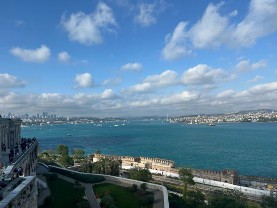
The view across two continents from the Topkapi Palace – including Erdogan’s Camlika Mosque in the distance on the right.
After the visitor to Topkapi has walked through three extraordinary courtyards, all of them surrounded by treasure-filled rooms, they are treated to a truly special view, that of the gleaming Bosphorus, the boundary between two continents, and the mega-city of Istanbul spread before them either side in all its gleaming glory. On the Asian side, one can see very clearly Erdogan’s latest (vanity?) project, opened in 2019, the 100,000 capacity Camlika Mosque, overlooking the whole of the city, and dwarfing even the Hagia Sofia. As I took in this view, I reflected on what a great day I had had, and my key takeaway from my all-too-short stint in Istanbul, that it is a city of potential tensions – of Asia and Europe, of Ottoman and Byzantine past, of Christianity and Islam – which nevertheless finds a way to deal with these in a workable manner. Long may this continue!
But now, time for an Efes!
Big fan:
Efes beer – speaks for itself!
Raki – actually really nice!
The hippodrome – totally free, and awesome!
The Blue Guide – the best, if you want proper guidance on history and art, and a source of some serious panic on my part when I believed I had left it in a restaurant!
Not a fan:
Turkish coffee – I didn’t really enjoy this – somehow too bitter and too sweet – and managed to spill some of it down my jumper for good measure!
Ticket pricing – given everything else is so cheap, the entry fees for foreigners for the Hagia Sofia and the Topkapi Palace are frankly extortionate! Plus I was conned in to buying a double ticket for Hagia Sofia, including a museum that I was never intending to visit!