

A Tale of Two Epic Conflicts
I am writing this from what is without doubt the smallest hotel that I have ever set foot in, the three-bedroom (!) ‘Elaia’ in Bergama, the modern-day town which has been built amongst the ruins of ancient Pergamum. I have also just heard that tomorrow I will encounter the first road block to my itinerary (having so far only added to it, unbelievably!), being informed by my host that the archaeological site of the ancient city will not be open until tomorrow afternoon due to it being the first day of Eid ul-Adha – something that was not foreseen by any website or any of my AI assistants… Never mind!
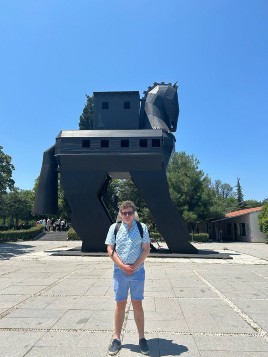
The author fulfilling one of his life dreams – to visit the site of Troy!
A key motivating factor behind me doing this trip was to visit the site of Troy, a city that has loomed over the entirety of my Classical education. For a long time, I have been fascinated not only by the wonderful literature and mythology that centres around Troy, but also the question of to what extent the famous stories are grounded in some sort of historical reality. Recent trips to the sites of Mycenae and Tiryns have compounded my interest in this question.
To illustrate briefly, the main challenge with assessing whether the mythological Trojan War has any historical grounding is that our oldest sources for that conflict – the Homeric epics of the Iliad and the Odyssey – were composed in their extant written versions at least four-hundred years after the Bronze Age setting of the events that they depict. The myths survived the four-hundred-year Dark Age that preceded the invention of the Greek alphabet via oral transmission, a poetic tradition of which scholars have long recognised that the Iliad and the Odyssey – both full of easily memorised type-scenes, formulae and epithets – are part.
On account of this four-hundred year time lapse between event and source, and the fact that the Homeric accounts of the Trojan War have been clearly and brilliantly ‘souped up’ with the involvement of heroes and gods, the only way to attempt to assess the veracity of a historical Trojan War is to turn to archaeology. And this is exactly what a Homer-fascinated amateur Heinrich Schiemann did in the late 1800s. On a life quest to solve the mystery of the historical Trojan War, and on the
recommendation of a similarly obsessed amateur, American Frank Calvert, in 1870 Schliemann brought his team to a somewhat unassuming hill in Western Anatolia called Hisarlik, some 30 kilometres south of the Turkish port at the mouth of the Dardannelles, Canakkale. Schliemann’s endeavours are a famous story of equal archaeological enterprise and violence. Using dynamite, he ripped the heart out of Hisarlik (and layers of precious arachaeology), in order to find his longed-for citadel of Priam. Try as he might – but perhaps unsurprisingly – for three years, he failed to find a city buried within Hisarlik that matched Homer’s depiction of Troy as ‘high-walled’, ‘well-built’, ‘rich in gold’ and ‘sacred’, but on June 15 1873 (the day before his operations were set to conclude), he made his long-awaited, game-changing find: the ‘Jewels of Helen’, part of ‘Priam’s Treasure’, some 9000 brilliantly wrought golden objects. Having famously dressed his wife Sophia in these jewels, Schliemann was convinced that he had solved the mystery which had driven much of his life. The problem: it was very quickly shown that ‘Priam’s Treasure’ and the ‘Jewels of Helen’ must be considerably older than any historical war about which Homer composed; it has since turned out that they are over a thousand years older than any possible historical Trojan War.
After discovery, ‘Priam’s Treasure’ has a fascinating afterlife which has resulted in it being currently housed in the Pushkin Museum in Moscow, but this is a story for another day.
All these stories of archaeological endeavour and intrigue are told brilliantly in the Troy gallery of the Archaeological Museum of Istanbul. Indeed that whole gallery is fantastic and I would recommend it to anyone wanting to get an idea of just how much of an archaeological palimpsest Hisarlik is – short of going to the site itself of course! From my experience of both of them, I would say that the aforementioned museum does a much better – and more interesting – job of this than the recently opened Museum of Troy at the site itself, which seems really to downplay the Homeric aspects of the site – understandable, perhaps, but that of course is the main reason why, for centuries, people all the way back to Alexander the Great and Julius Caesar have made the pilgrimage to Hisarlik!
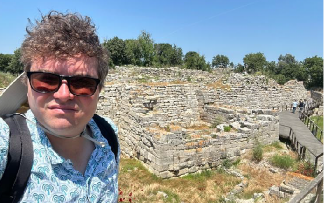
The walls of Troy VI – the ‘well-built’ walls of Homer’s Troy?
But if Schliemann blew it all apart, what is actually at Hisarlik itself? Well, thankfully quite a lot, thanks to the excellent work of Schliemann’s successors, first Wilhelm Dorpfeld and then Carl Blegen. The first identified no fewer than nine cities on the site, and excavated the towering walls of Troy VI – the one from the thirteenth century BC – corresponding with the zenith of the Mycenaean period in Greece, and the latter did much to uncover Troy VII, another (perhaps more likely?) contender for Homer’s Troy. The sprawling site itself is brilliant to walk around – you stay on one elevated walkway the whole way round and get a real sense of the many layers of Hisarlik. It is also tantalising to compare the modern-day feel and topography of the site with Homer’s description of it. For one thing, as per Homer’s depiction of Troy as ēnemoessa, the top of Hisarlik is indeed very windy – something that almost cost me my hat! For another, the hill perfectly fits the location depicted in Homer. From the top (Priam’s Citadel?), you gaze out over a flat plain that extends to the Aegean (the plain of Ilium?) with the island of Bozcada (Tenedos?) lurking just offshore. As you walk past the slightly slanted (as per the Iliad), ‘brilliantly built’ walls of Troy VI (with its massive towers), it is hard not to consider the possibilities of whose footsteps one might be walking in…
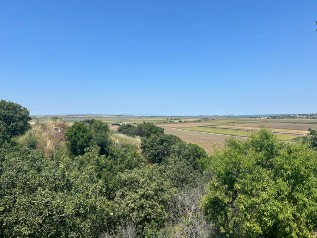
The view from Hisarlik over the plain of Ilion.
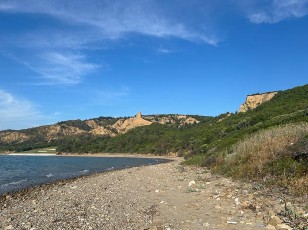
‘Anzac Cove’ – Beautiful now, but setting of one of the bloodiest battles of WW1.
During my free time tomorrow, I think I will expand more on my thoughts about the veracity of the Trojan War, but for now, I want to touch on some of the other things that I have done over the past 48 hours. Feeling that yesterday (Istanbul to Canakkale) may have just ended up as a lot of driving, I decided to do a whistle-stop tour of the beaches of Gallipoli in the evening, before crossing the Dardanelles into my base for the night. On my four-hour drive from Istanbul, I had listened to two episodes of the Rest is History on the subject, which had equipped me brilliantly for what I was going to see. The drive from ANZAC Cove up the cliff to the various memorials is truly stunning and heart-wrenching – so grim are the stories of the heroes on both sides that fought there.
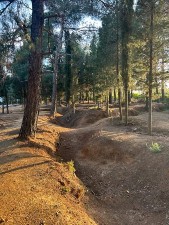
The Trenches of Gallipoli
Given the purpose of my trip, I found the way in which the Gallipoli campaign inherits the legacy of the Trojan War particularly fascinating. For example, on being assigned to Gallipoli, that most patriotic of war poets, Rupert Brooke, was apparently exhilarated by the opportunity to walk in the footsteps of Achilles, and perhaps die a similarly heroic death, but the reality could not be further removed – death en route from sepsis via a mosquito bite. Likewise, Oxford Classicist and British naval commander Edward Unwin had supposedly been actively inspired by the Trojan Horse in his plans to beach deliberately the HMS River Clyde at Cape Hellas – a ruse that in this case did not break the deadlock, but caused a bloody disaster for the British. These anecdotes show just how big an influence the heroic tales of the Trojan War have had on participants in later conflicts – in reality, a much more significant issue than the question of whether the mythological conflict is grounded in some historical reality.
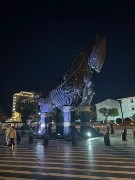
The Trojan Horse of Canakkale
And what else have I done? Well, Canakkale as a city far surpassed my expectations. It is aware of its heritage, with nods to the Trojan War and the Gallipoli Campaign all over the place, and it also (as I found out on a Monday) has a thriving night life!
En route from Troy to Bergama, I stopped at the ancient city of Assos above Behramkale, which has a wonderful temple to Athena situated high on an acropolis with stunning views out to the island of Lesbos, though if driving there, please see below!
I now move on to the Hellenistic section of my trip, with the mega-cities of Pergamum and Ephesus to see over the next couple of days,
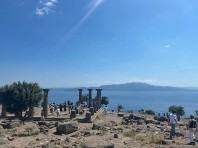
The view of Lesbos from the Temple of Athena at Assos
But now, time for an Efes!
Big fan:
Podcasts and audiobooks when driving – have never really done this before, but listened to the Rest is History in advance of my Gallipoli adventure and am now nine books through Emily Wilson’s translation of the Iliad (brilliantly narrated by Audra Macdonald!)
Turkish hotel breakfasts – basically anything you want!
Turkish motorways – very easy to drive on!
The Troy gallery of the Archaeological Museum of Istanbul.
Nightlife of Canakkale – a real surprise…
The stunning, rural, inland second half of the drive from Assos to Pergamum.
The views of Lesbos from Assos.
Not a fan of:
Driving on Turkish back streets – never attempt to drive through Behramkale, the village beneath Assos!
Being brutally honest, the new museum at the site of Troy (though, to be fair, several of their finds are currently being exhibited at Rome).
The first half of the drive from Assos to Bergama – a slow coastal road with quite a lot of mayhem!