

Florence – In the Footsteps of Masters
A tour for those studying Art and Design, in the city that birthed the Renaissance, home to pieces by the greatest artists of the era. Visit lavishly decorated palaces and explore galleries and museums full to the brim with art, keep your eyes peeled for modern street art as you explore the city of the Medici.
The programme can be edited to include archaeological sites and museums specific to your areas of study.
If you require a quotation, send us your wish list!
Day 1
Land in Pisa, meet courier and coach for transfer to Florence Hotel for check in and luggage drop off. Depart on foot for Casa Buonarotti (the family home of Michelangelo) inside which you will find a small archaeological collection assembled by the family, a wider family collection, rooms dedicated to eulogising Michelangelo, sketches and models by the artist, two reliefs sculpted in his youth “Madonna della Scala” and “Battaglia dei Centauri”, a studio decorated with famous Florentines, as well as other exhibition halls.
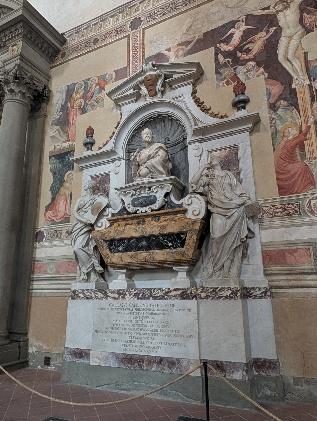
<Figure 1: Tomb of Galileo at Santa Croce
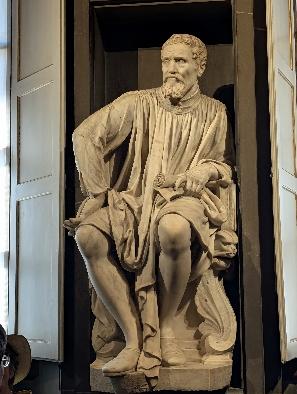
<Figure 2: Statue of Michelangelo at Casa Buonarotti
A short walk away is Santa Croce, one of the most important churches in the city. Dating back to the 13th Century it holds over 4000 works of art dating from that period up to the 20th Century. Some of the most important pieces in the basilica are the Tombs of the Greats, where Michelangelo, Machiavelli, Galileo and others were all laid to rest alongside the Cenotaph to Dante. These tombs are superb works of art themselves.
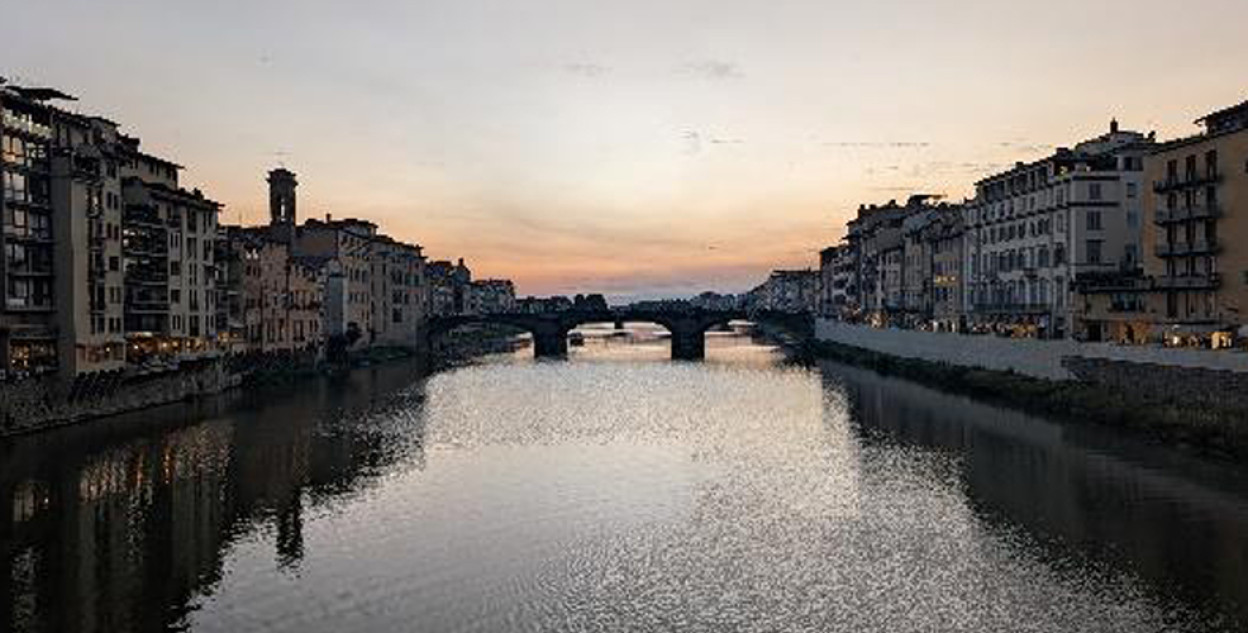
Head towards Ponte Vecchio to capture stunning photos of the golden light reflecting on the River Arno. Central Florence lacks large scale street art and graffiti, but keep your eyes peeled for the poster art by Blub “L’arte sa nuotare” featuring celebrities and famous artwork styled in swimming goggles and water settings. You may also spot road signs that have been adapted by the French artist Clet Abraham to become street art using stickers.
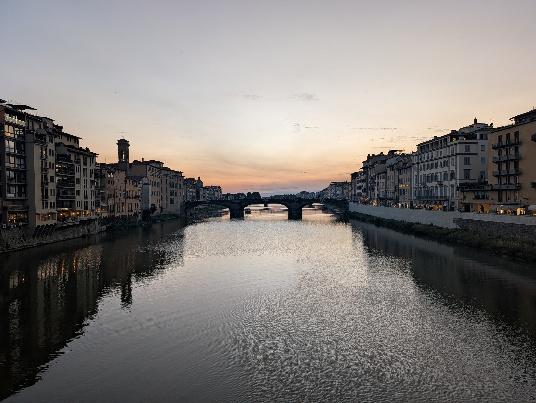
<Figure 3: The evening light from Ponte Vecchio
Head to the local trattoria for dinner before returning to the hotel.
Day 2
Depart on foot after breakfast to the Uffizi Gallery, one of the greatest art galleries in the world, and as such, rather busy. Luckily, there are enough rooms through which the crowds can disperse easily enough. The first area of the gallery, a square-bottom U, is dedicated to Greco-Roman art, with busts and statues looking down on you from all sides. Off this gallery you can find rooms A3-A42 which include works by Botticelli, Giotto, Michelangelo, Raphael, Da Vinci and Pietro della Francesca, plus further Greco-Roman statuary. The highlights of this floor include the Birth of Venus and Spring by Botticelli, the Venus de’ Medici, and the porphyry She Wolf.
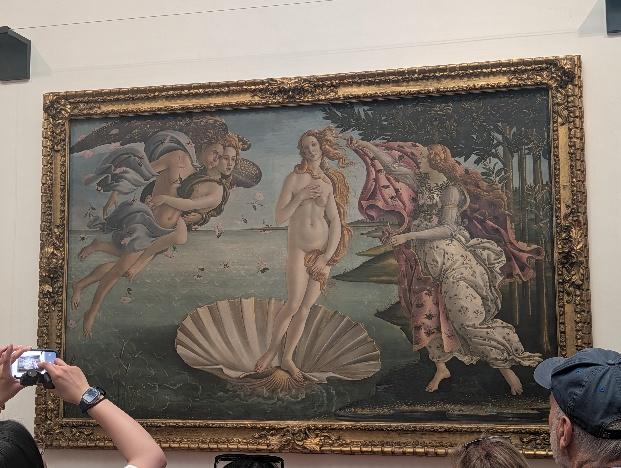
<Figure 4: Birth of Venus by Botticelli, Uffizi Gallery
By following the route round and going downstairs, you will find more masterpieces including sculptures by Bernini, and paintings by Bronzino, Titian, Rembrandt, Rubens, Van Dyck, and many, many others. The pieces are grouped by theme and date. The masterpieces here are Caravaggio’s Head of Medusa and Bacchus, as well as Artemisia Gentileschi’s Judith Slaying Holofernes.
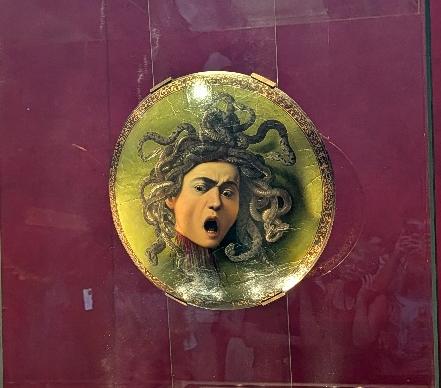
<Figure 5: Caravaggio’s Head of Medusa, Uffizi Gallery
Lunch may be obtained in one of several panini bottegas not too far from the Piazza della Signoria, before heading south of the river to Palazzo Pitti and Boboli Gardens.
It is entirely up to you as to which one you visit first, but you may prefer initially to roam outside after being in the Uffizi all morning.
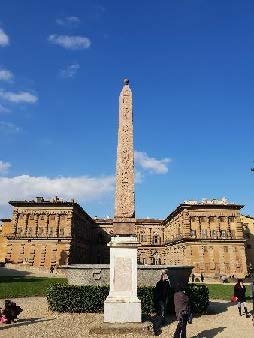
<Figure 6: The Boboli Garden Obelisk
The Boboli Gardens were created by the Medici family having moved residence from Palazzo Vecchio. It features several grottos and large fountains, the antifeatro space which includes an obelisk (twin of the Dogali obelisk in Rome), the Kaffeehaus, Meadow of the Columns, Knight’s Building Porcelain Museum, Cypress Lane and the Lemon House. Both ancient and Renaissance Statues are dotted throughout, turning the garden into an outdoor museum. There is also a fine view over the city.
Having had your fill of fresh air, head into Palazzo Pitti. This is split into five museum spaces: The Treasury of the Grand Dukes, Museum of Russian Icons, the Palatine Gallery (featuring the Imperial and Royal Apartments), the Gallery of Modern Art and the Museum of Costume and Fashion. The Treasury of the Grand Dukes set in the summer apartments of the Medici, on the ground floor of the palace, comprises of pieces made from precious and semi-precious stones, silverware, and jewellery. The Museum of Russian Icons is also situated on the ground floor and is the largest collection of Russian art in the western world. The Palatine Gallery is the Medici family’s collection of paintings and statuary, on the lavishly decorated first floor. You will first encounter an array of Roman statues and busts. The subsequent galleries showcase the largest concentration of Raphael’s work in the world, complemented by pieces from Titian, Gentileschi, and Botticelli.
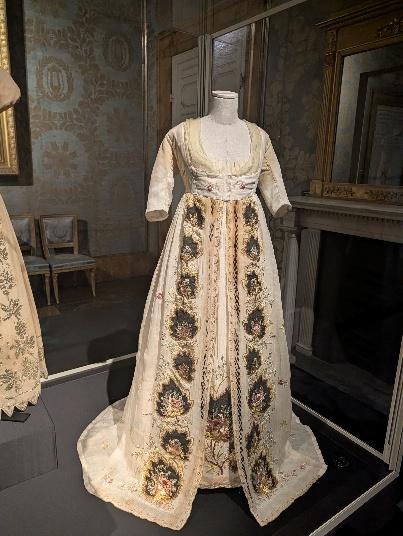
<Figure 7: A 18th C. women’s gown, Palazzo Pitti
If you go up a floor, you will find the Gallery of Modern Art which features works from the 18th-20th Centuries. As you follow the chronological route, keep your eyes peeled for the miniature of the Column of Trajan and the bust of Napoleon. Lastly, the Museum of Costume and Fashion features clothing and jewellery from the 18th Century to the modern era, displayed on a rotation basis to assist preservation. There’s a set route through this last museum space too, although it is far smaller than the Palatine Gallery and Gallery of Modern Art.
Exit the Palazzo Pitti and head back towards the centre to find your local trattoria for dinner.
Day 3
After breakfast depart on foot for the Galleria dell’Accademia to begin your day with the masterpiece of Renaissance sculpture that is Michelangelo’s David. Also on view are works of Ghirlandaio, the unfired clay model of The Rape of the Sabine Women by Giambologna, and a room full of plaster models from various artists which allow for greater understanding of the creative process. On the first floor you will be able to see plenty of tempera on wood panel pieces, as well as the incredibly detailed linen altar front from Santa Maria Novella – one of the highest quality examples of Florentine embroidery.
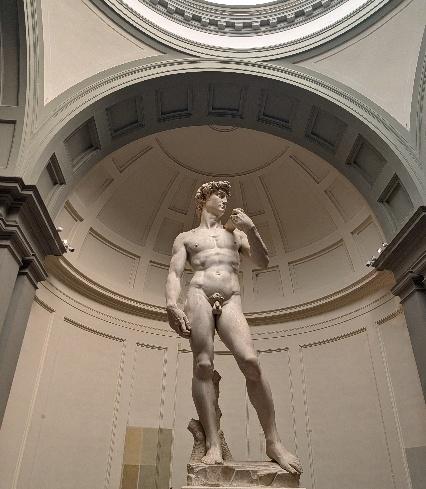
<Figure 8: Michelangelo’s David
On your way south stop at one of the Leonardo Da Vinci Museums situated within a few metres from each other. The larger concentrates more on anatomical studies, digital displays and working models. The smaller offers mechanical reconstructions and workshops. Both are interactive.
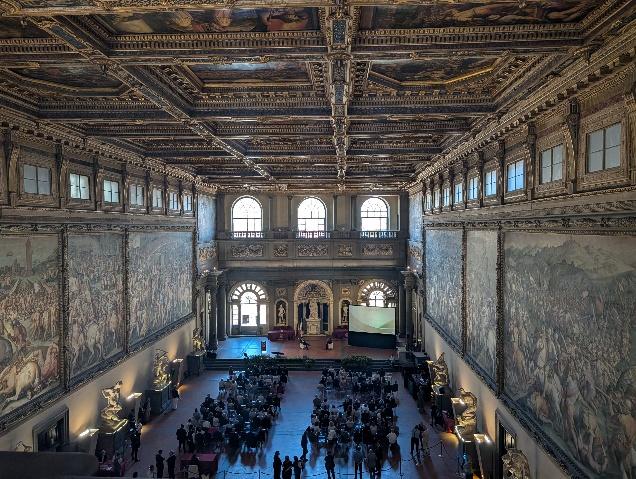
<Figure 9: The Great Hall at Palazzo Vecchio
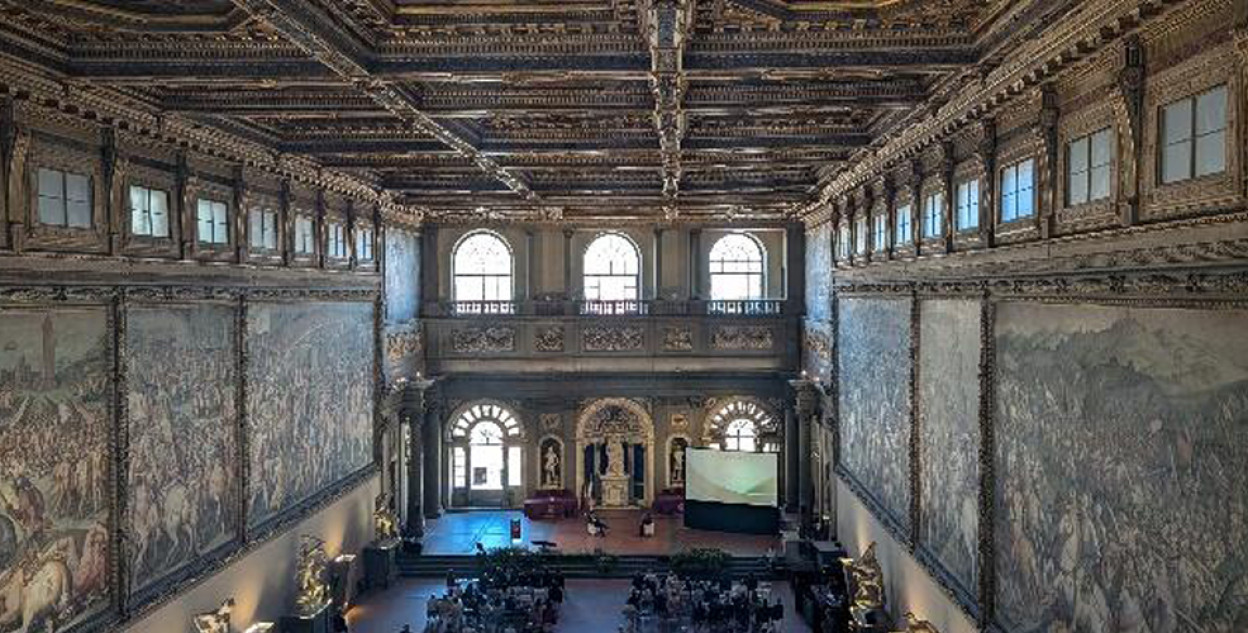
Head south to Piazza della Signoria, stop at the Loggia dei Lanzi for various statuary. Be sure to spot the graffiti of a face by Michelangelo on the wall of the Palazzo Vecchio (to the right of the entrance) before going in to the Palazzo. If you are here on a Saturday or Sunday you will be lucky enough to be able to view the Roman Theatre beneath the Palazzo, but if not, then continue up the stairs to enter the Great Hall to marvel at the enormous 16th Century paintings covering the walls, and the little studiolo tucked away in the back corner. This was dismantled shortly after being built and wasn’t reassembled until the 20th Century. Having been the original seat of power for the Medici, Palazzo Vecchio is just as lavishly decorated as Palazzo Pitti’s Imperial and Royal Apartments. On the first level are rooms dedicated to members of the Medici family.
The Quarters of the Elements on the second floor is dedicated to a mythological character matching a room of a Medici Family member below. The Room of the Elements of course matches exactly the room of the Medici Pope Leo X. Just as all things in the universe originated from the four elements (fire, water, earth, air), Leo X laid the foundations of the de’ Medici Duchy of Tuscany. The rooms of the Palazzo Vecchio are populated by marvellous paintings, ancient statuary and furniture. Most however, pale in comparison to the Hall of Lilies, with its repeated gold fleur de lys on a blue background (the Angevin emblem) and the marquetry figures of Dante and Petrarch on the door. The route ends with the Hall of Geographical Maps and the Loeser Bequest.
Make your way back down to the Piazza della Signoria stop for lunch before visiting Museo Ferragamo.
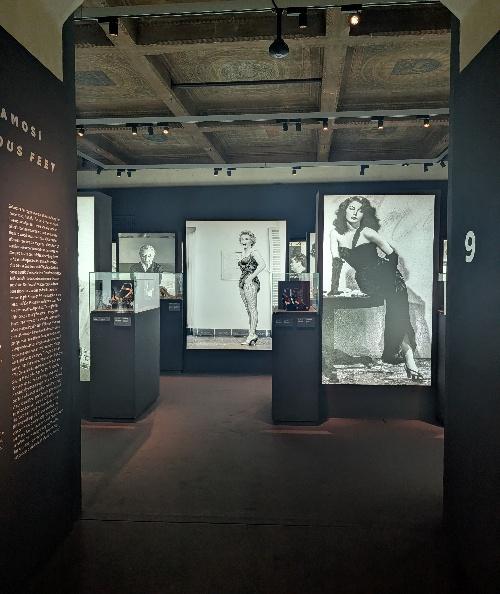
<Figure 10: The Shoes and Famous Feet gallery at Museo Ferragamo
The Ferragamo Museum is a small museum dedicated to the life and work of Salvatore Ferragamo, the Italian shoemaker. Sitting in Piazza di Santa Trinita, underneath the Ferragamo store, the museum itinerary starts with a section on his life, from birth in the late 19th Century through to the middle of the 20th Century. The following rooms offer a collection of the shoes created by Salvatore, video pieces on his first workshop in Hollywood, the architectural forms in his work, the inspiration for his work (including samurai armour and taxidermized birds), a room dedicated to the 18-carat sandals he created in 1956, and creativity in colour with a rainbow wall of shoes. The last section of the museum is Shoes and Famous Feet where you will find the shoes (and large black and white photos) of the actresses who wore them, usually with Mr. Ferragamo alongside, including Marilyn Monroe, Audrey Hepburn, Sophia Loren, and Ingrid Bergman.
Finish in the museum and then head out for dinner at a local trattoria.
Day 4
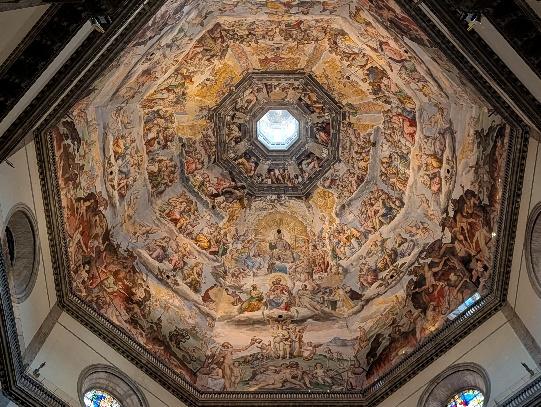
<Figure 11: The inside of the Dome at Santa Maria del Fiore
Once you have eaten breakfast and checked out, store your luggage at the hotel and depart on foot for Santa Maria del Fiore otherwise known as Il Duomo. You will have walked past it several times, but now you must queue for entrance. If requested we can leave you to visit the Basilica on its own (free entry), but should you wish to see Brunelleschi’s dome up close, we must pre-book tickets and you must queue elsewhere.
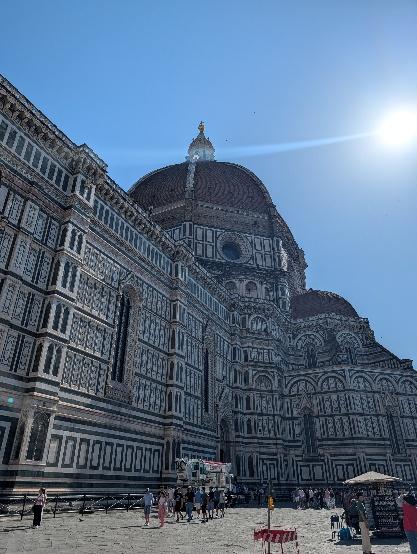
<Figure 12: Il Duomo from the outside
The 15th Century dome is the largest unreinforced masonry dome in the world, a triumph of architectural design and a symbol of the Renaissance. Visitors can climb up and walk inside the dome on balconies to view the Last Judgement by Vasari and Zuccari on the vault. The Brunelleschi Pass ticket that allows you to climb the dome also allows access to the Baptistry of St. John, the underground basilica of Santa Reparata, the Opera del Duomo Museum and Giotto’s Bell Tower, as well as the Cathedral itself. It is up to you how many of these you wish to see, but each one has a variety of artworks and architectural design elements of interest, such as the 13th-14th Century Byzantine style mosaics of the Baptistry, the art of Michelangelo, Donatello and Ghiberti in the Opera del Duomo Museum, or the early Christian mosaic floor at Santa Reparata.
It is only a short walk to the first family residence of the Medici family at Palazzo Medici Riccardi, commissioned in 1444. Depending on how many of the Duomo adjacent sites you visit, you may need to stop for lunch first before entering the Palazzo.
Once inside the Palace, the museum space is split across several floors – the underground has an archaeological itinerary where you can see the remains of buildings from the site’s history as well as pieces found during the excavations. The Marble Museum is also underground and features the selection of sculptures that belonged to the Riccardi family.
The courtyard, designed by Michelozzo to be the heart of the palace displays a balanced architectural style of arched arcades and friezes. The Riccardi family added eight Baroque frames in the 18th Century to host a collection of ancient sculptures and inscriptions.
The Salon Charles VIII has a series of 17thCentury tapestries depicting the stories of Samson from the bible.
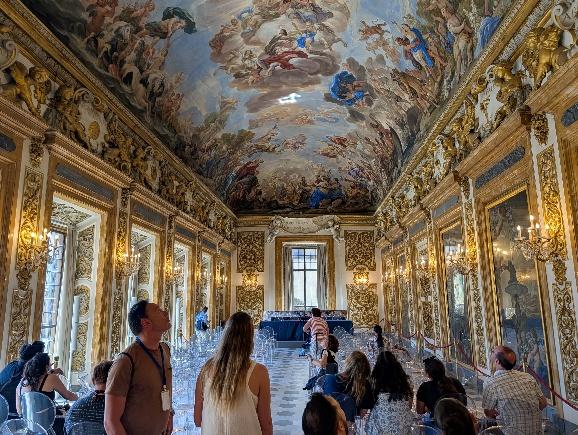
<Figure 13: The Mirror Gallery at Palazzo Medici Riccardi
The last highlight in the Palace is The Mirror Gallery, a masterpiece of Florentine Baroque art, it overlooks the Medici Garden and the mirrors on the walls are painted with cherubs, animal and plant motifs, which alternate with intricately carved and gilded cabinets. The ceiling was painted with a depiction of the Apotheosis of the Medici dynasty in the late 17th Century.
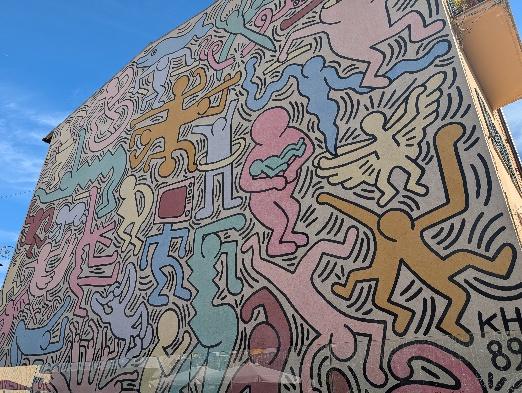
<Figure 14: Keith Haring’s Tuttomondo, Pisa
Return to your hotel, collect your luggage and depart for Pisa where you can have a brief stop to see the architectural marvel that is the Leaning Tower, and if time, Keith Haring’s Tuttomondo on a wall near the train station. Afterwards head to the airport for your evening flight home.
Feel free to contact us to tailor your own tour. 01342 324727
Optional Extras
- Florence Archaeological Museum – Egyptian, Etruscan, Greek and Roman art
- Museo Nazionale del Bargello – Renaissance Art Museum
- Cattedrale dell’Immagine – Immersive Art experience in a deconsecrated church
- Museo Novecento – Modern Art museum
- ONART Gallery Firenze – Art Gallery
- Climbing up to Piazza Michelangelo or San Miniato al Monte to see the view over the city – stunning but the former is very busy around sunset.
- Museo Galileo – Museum dedicated to the sciences